Blog dedicated to reporting on Mexican drug cartels
on the border line between the US and Mexico
.

Monday, February 28, 2022

At Cartel Extermination Site; Mexico Nears 100k Missing

"Sol Prendido" for Borderland Beat


For the investigators, the human foot -- burned, but with some fabric still attached -- was the tipoff: Until recently, this squat, ruined house was a place where bodies were ripped apart and incinerated, where the remains of some of Mexico’s missing multitudes were obliterated.

How many disappeared in this cartel “extermination site” on the outskirts of Nuevo Laredo, miles from the U.S. border? After six months of work, forensic technicians still don’t dare offer an estimate. In a single room, the compacted, burnt human remains and debris were nearly 2 feet deep.

Uncounted bone fragments were spread across 75,000 square feet of desert scrubland. Twisted wires, apparently used to tie the victims, lie scattered amid the scrub.

Each day, technicians place what they find -- bones, buttons, earrings, scraps of clothing -- in paper bags labeled with their contents: “Zone E, Point 53, Quadrant I. Bone fragments exposed to fire.”

They are sent off to the forensic lab in the state capital Ciudad Victoria, where boxes of paper bags wait their turn along with others. They will wait a long time; there are not enough resources and too many fragments, too many missing, too many dead.

At the Nuevo Laredo site -- to which The Associated Press was given access this month -- the insufficiency of investigations into Mexico’s nearly 100,000 disappearances is painfully evident. There are 52,000 unidentified people in morgues and cemeteries, not counting places like this one, where the charred remains are measured only by weight.


A skull sits on a shelf at the forensics lab in Ciudad Victoria, Mexico, Friday, Feb. 4, 2022. The official total of Mexico’s missing is nearly 100,000.


Mexicans search for their missing loved-ones, as forensic teams investigate burned out houses where human remains have been found. 

And people continue to disappear. And more remains are found.

“We take care of one case and 10 more arrive,” said Oswaldo Salinas, head of the Tamaulipas state attorney general’s identification team.

Meanwhile there is no progress in bringing the guilty to justice. According to recent data from Mexico’s federal auditor, of more than 1,600 investigations into disappearances by authorities or cartels opened by the attorney general’s office, none made it to the courts in 2020.

Still, the work goes on at Nuevo Laredo. If nothing else, there is the hope of helping even one family find closure, though that can take years.


Forensic technicians excavate a field on a plot of land referred to as a cartel "extermination site" where burned human remains are buried, on the outskirts of Nuevo Laredo, Mexico, Tuesday, Feb. 8, 2022. (AP Photo/Marco Ugarte)

Forensic technicians excavate a field where uncounted of human bone fragments are spread across 75,000 square feet of this desert scrubland, on the outskirts of Nuevo Laredo, Mexico, Tuesday, Feb. 8, 2022. 

That’s why a forensic technician smiled amid the devastation on a recent day: She had found an unburnt tooth, a treasure that might offer DNA to make an identification possible.

When Jorge Macías, head of the Tamaulipas state search commission, and his team first came to the Nuevo Laredo site, they had to clear brush and pick up human remains over the final 100 yards just to reach the house without destroying evidence. They found a barrel tossed in a trough, shovels and an axe with traces of blood on it. Gunfire echoed in the distance.

Nearly six months later, there are still more than 30,000 square feet of property to inspect and catalog.

The house has been cleared, but four blackened spaces used for cremation remain. In what was the bathroom, it took the technicians three weeks to carefully excavate the compacted mass of human remains, concrete and melted tires, said Salinas, who leads work at the site. Grease streaks the walls.

Macías found the Nuevo Laredo house last August when he was looking for more than 70 people who had disappeared in the first half of the year along a stretch of highway connecting Monterrey and Nuevo Laredo, the busiest trade crossing with the United States.

The area was known as kilometer 26, a point on the highway and the invisible entrance to the kingdom of the Northeast cartel, a splinter of the Zetas. There are small shops with food and coffee. Men sell stolen gasoline and drugs. Strangers are filmed with cell phones. The power poles lining the highway farther north have been blasted with large-caliber weapons.

Most who disappeared here were truck drivers, cabbies, but also at least one family and various U.S. citizens. About a dozen have been found alive.

Forensic technicians excavate a field on a plot of land referred to as a cartel "extermination site" where burned human remains are buried, on the outskirts of Nuevo Laredo, Mexico, Tuesday, Feb. 8, 2022.
Jorge Macias, head of the Tamaulipas state search commission, uses a two-way radio while walking on a field on the outskirts of Ciudad Victoria, Mexico, Thursday, Feb. 3, 2022. 

A National Guardsman hands a bucket to a forensic technician during an excavation on a plot of land referred to as a cartel "extermination site" where burned human remains are buried, on the outskirts of Nuevo Laredo, Mexico, Tuesday, Feb. 8, 2022. 

Last July, Karla Quintana, head of the National Search Commission, said the disappearances appeared to be related to a dispute between the Jalisco New Generation cartel, which was trying to enter the area, and the Northeast cartel, which wanted to keep them out. It’s not clear if the victims were smugglers of drugs or people, if some were abducted mistakenly or if the goal was simply to generate terror.

The phenomenon of Mexico’s disappearances exploded in 2006 when the government declared war on the drug cartels. For years, the government looked the other way as violence increased and families of the missing were forced to become detectives.

It wasn’t until 2018 -- the end of the last administration -- that a law passed, laying the legal foundations for the government to establish the National Search Commission. There followed local commissions in every state; protocols that separated searches from investigations, and a temporary and independent body of national and international technical experts supported by the U.N. to help clear the backlog of unidentified remains.

The official total of the missing stands at 98,356. Even without the civil wars or military dictatorships that afflicted other Latin American countries, Mexico’s disappeared are exceeded in the region only by war-torn Colombia. Unlike other countries, Mexico’s challenge still has no end: authorities and families search for people who disappeared in the 1960s and those who went missing today.

President Andrés Manuel López Obrador’s government was the first to recognize the extent of the problem, to talk of “extermination sites” and to mount effective searches.

But he also promised in 2019 that authorities would have all the resources they needed. The national commission, which was supposed to have 352 employees this year, still has just 89. And Macías’ state commission has 22 positions budgeted, but has only filled a dozen slots. There the issue isn’t money; the difficulty is finding applicants who pass background checks.

Disappearances are considered the perfect crime because without a body, there’s no crime. And the cartels are expert at ensuring that there is no body.

“If a criminal group has total control of an area they do what we call ‘kitchens,’ because they feel comfortable” burning bodies openly, Macías said. “In areas that are not theirs and where the other side could easily see the smoke, they dig graves.”

In 2009, at the other end of the border, a member of the Tijuana cartel confessed to having “cooked” some 300 victims in caustic lye. Eight years later, a report from a public university investigation center showed that what officially had been a jail in the border city of Piedras Negras, was actually a Zetas command center and crematorium.

Alejandro Lopez, part of a collective of relatives who search for disappeared persons, sifts through dirt taken from a clandestine grave in a field on the outskirts of Ciudad Mante, Mexico, Tuesday, Feb. 1, 2022
Teeth recovered by forensic technicians are collected on a screen during an excavation on a plot of land referred to as a cartel "extermination site", on the outskirts of Nuevo Laredo, Mexico, Tuesday, Feb. 8, 2022
A forensic technician holds a charred jawbone found during an excavation on a plot of land referred to as a cartel "extermination site" where burned human remains are buried, on the outskirts of Nuevo Laredo, Mexico, Tuesday, Feb. 8, 2022. 

Perhaps the largest such site was yet another border setting near the mouth of the Rio Grande called “the dungeon,” in territory controlled by the Gulf cartel. The memory still stirs Macías. The first time he went he saw “pelvis, skulls, femurs, everything just lying there and I said to myself, ‘It can’t be.’”

Authorities have recovered more than 1,100 pounds of bones at the site so far.

According to the Tamaulipas state forensic service, some 15 “extermination sites” have been found. There are also burial sites: In 2010, graves containing 191 bodies were found along one of the main migratory routes through Tamaulipas to the border. In 2014, 43 students disappeared in the southern state of Guerrero. Only three have been identified from pieces of burnt bones.

Most of the extermination sites have been found by family members who follow up leads themselves with or without the support and protection of authorities. Such search groups exist in nearly every state.

For the families, the discoveries inspire both hope and pain.

“It brings together a lot of emotions,” said a woman who has been searching for her husband since 2014 and two brothers who disappeared later. Like thousands of relatives across Mexico, she has made the search for her loved ones her life. “It makes you happy to find (a site), but at the moment you see things the way they are, you nosedive.”

The woman, who requested anonymity because of safety concerns, was present for the discovery of two sites last year. When she entered the Nuevo Laredo location with Macías, she could only cry.

A few months earlier, she had found the site in central Tamaulipas where she believes her loved ones are. That day, accompanied by the state search commission and escorted by the National Guard, they entered the brush in search of a drug camp.

“I’m not well psychologically after that,” she said as she showed photos of the deep graves where burnt remains were buried, some wrapped in barbed wire. They recovered around a thousand teeth, she said.

On a recent day in Nuevo Laredo, gloved hands sifted through the dirt, separating out bits of bone: a piece of a jaw, a skull fragment, a vertebra.

The work is hard. The forensic technicians clear brush and then dig. Some days the temperature hovers around freezing, others it’s above 100 degrees. They wear head-to-toe white protective suits and are constantly guarded.

Security is a concern, and so authorities have separated the search function from the investigations -- the cartels appear less concerned with those just looking for bones, though anything they find could eventually become evidence in a prosecution. Each day before dusk, they are escorted to a safe house and don’t leave except to return the next day to the site.

A forensic technician holds a bag of evidence collected during an excavation on a plot of land referred to as a cartel "extermination site" where burned human remains are buried, on the outskirts of Nuevo Laredo, Mexico, Tuesday, Feb. 8, 2022.

When cartel violence exploded in Tamaulipas in 2010, the capital’s morgue had space for six bodies. In a single massacre that year, a cartel killed 72 migrants. In those days, the Interamerican Commission of Human Rights denounced serious negligence in Tamaulipas’s forensic work.

Pedro Sosa, director of the state’s forensic services, said that their way of working changed radically in 2018 with the establishment of the identification team. But it’s not enough. “A single forensic anthropologist in the whole state is not compatible with all of this work.”

It can take four months for the Nuevo Laredo remains to be cleaned, processed and arrive to the genetic lab. It can take longer if something urgent emerges like in January of last year, when nearly 20 people -- mostly migrants -- were incinerated in an attack near the border.

Even if they manage to extract DNA, identification isn’t assured because the profile will only automatically be crossed with a state database.

It could be years before the profile is added to one of the national databases. In 2020, the federal auditor said that that system had only 7,600 registered disappeared and 6,500 registered dead.

Though the federal law calls for a system in which various databases can interact, that doesn’t exist, said Marlene Herbig, of the International Committee of the Red Cross. Each state or federal database of fingerprints or genetic profiles is like an island, despite calls for bridges to connect them.

No one can estimate how much money is needed or how many years it could take to see significant results in Mexico’s efforts to locate and identify the disappeared.

Herbig offered a clue: A similar effort mounted on the island of Cyprus took 10 years to identify 200 disappeared in the conflict between Greece and Turkey during the latter half of the last century. And there are many thousands more missing in Mexico than there were in Cyprus.

“This issue is a monster,” Macías said.

A technician organizes bone fragments at the forensic lab in Ciudad Victoria, Mexico, Friday, Feb. 4, 2022. 


A technician photographs bone fragments at the forensic lab in Ciudad Victoria, Mexico, Friday, Feb. 4, 2022.


Forensic technicians investigate on a plot of land known as a cartel "extermination site" where burned human remains are buried, on the outskirts of Nuevo Laredo, Mexico, Tuesday, Feb. 8, 2022. 

ap news

Cocaine In The Post Allegations In Cartel-Linked Drugs To NZ, Cash To Mexico Case

"Sol Prendido" for Borderland Beat

Stuff has obtained court documents that have shed new light on an alleged cocaine importation plot, including deliveries of the drug to suburban addresses and cash transfers to Mexican banks.

New details have emerged about an alleged Mexican Cartel-linked plan to import large quantities of cocaine and methamphetamine into New Zealand, including cocaine deliveries to suburban Rotorua addresses and cash transfers to Mexico.

Stuff has obtained the Crown Charge Notice for the nine men arrested as part of the National Organised Crime Group’s Operation Tarpon, which Acting Detective Inspector John Brunton said targeted key players in a Cartel-linked drug syndicate.

The men are Tangaroa Demant , James Dickson, Allison Dos Santos, Angel Gavito Alverado , Jeffrey Gear, Manual Moreno Gonzalez, Maurice Swinton, Tama Waitai and Ryan Walsh.

Swinton was employed at a stevedoring business contracted to the Port of Tauranga.

All pleaded not guilty to a raft of charges including conspiracy to import cocaine, importing cocaine, money laundering, possession of cocaine for supply, conspiracy to import methamphetamine, possession of methamphetamine for supply, conspiracy to manufacture methamphetamine, unlawful possession of a firearm and cultivating cannabis.

Some charges carry a maximum penalty life imprisonment, and some alleged offending stretches back to 2020.

They are set to reappear for a call over at the High Court in Tauranga in June.

The Crown Charge Notice alleges that during 2020 and 2021 packages containing cocaine, one containing 300g of the drug, were sent to suburban properties in Rotorua.

A package containing 215g of methamphetamine was also alleged to have been sent.

Auckland addresses were also alleged to have received packages with 300g and 310g amounts of cocaine and one alleged to contain 215g of methamphetamine.

Members of the group are also alleged to have been in possession of a “container of liquid methamphetamine”.

Alverado is also alleged to have deposited $20,600 into a bank account in New Zealand on January 14 last year, six days later transferring $19,676 “to a bank account in Mexico”.

At the time of the men’s arrest in April last year, Brunton said it had been the result of an eight-month-long investigation involving more than 100 police and customs staff.

stuff

GOPES Strike Back At CDG Los Metros in Tamaulipas

 “HEARST” for Borderland Beat


Following the two nights in a row in which members of the Gulf Cartel faction Los Metros shot out and destroyed video surveillance cameras, the special operations group of the State Police cracked down on organized crime in the area, leading to the seizure of tons of valuable equipment. 


Warning: Graphic images below this point. 


The Press Release 

On the night of February 24 until the night of February 26, 2022, Los Metros systematically shot out the government surveillance cameras located in the city of Reynosa and some in La Ribereña region of the state of Tamaulipas. For more details on why they took out the surveillance cameras, please see this previous Borderland Beat story


In response to this, law enforcement within the state allegedly went out of their way to locate, detain, and seize people or equipment related to organized crime. 


On February 26, 2022, a press release was sent out by the office of Tamaulipas’s Secretary of Public Security. It read as follows: 

Valparaíso, Zacatecas: Cartel Jalisco Gunmen Show Fallen Sinaloa Hitmen

"Sol Prendido" for Borderland Beat


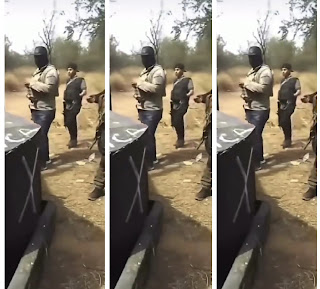
A video has surfaced from gunmen belonging to a CJNG cell. This broadcast shows the beheaded bodies of several sicarios from the "Operativo Mayo Zambada" (CDS). 

They were killed following a handful of armed clashes that took place in the Valparaíso mountains on February 24 and 25. 

The decapitated heads are spread across the terrain. One lies in full view near the corpse. While the other lays amongst the shrubbery. 


Video translation is as follows:


Sicario #1: Take a look at this here. We are the absolute 4 letters cartel. Check this out. I thought you guys couldn’t be hit? Where’s all that fucking bravery you guys were claiming, along with all that other shit? So, what do you think buddy? Did it not go well for us?

Sicario #2: Affirmative. We’ve just fucked them. 

Sicario #1: There lies the body of another son of a bitch over there. 


El Blog de Los Guachos

Cartels Involved in Wildlife Trafficking to China for Precursor Chemicals

"Socalj" for Borderland Beat

Mexican cartels are branching out from the illegal drug business into wildlife crime, including Jaguars being sold in China as Latin Tiger. 

Brookings Institution senior fellow Vanda Felbab-Brown has found links between the Mexican cartels and trafficking of fish and other marine species as well as trading in other illegal wildlife products. They are also sometimes being paid in chemicals to be used in the manufacture of drugs such as methamphetamine and fentanyl, according to the research.

Detailed in a soon-to-be-released report from the US-based think tank, Dr. Felbab-Brown has found things such as body parts of jaguars are being smuggled from Mexico to China for use in traditional Chinese medicine or to be consumed. The report suggests Mexican drug cartels are trading illegal wildlife for precursor chemicals used in the production of fentanyl among other drugs. 

Reptiles, sea cucumbers, abalone, and shark fins are also being trafficked from Mexico to China, sometimes via the US, she said. Her findings are drawn from 73 interviews with current and former officials, environmental groups, fishers, and others in Mexico, China, the United States, and elsewhere. All were conducted on the condition of anonymity.

“It’s really not been known at all how much the wildlife trafficking and poaching in Mexico are taking off and smuggling to supply the market in China,” Dr. Felbab-Brown said in the Brookings Trade podcast. “It’s all the more interesting because the wildlife trafficking there intersects with the drug trafficking.”

A connection between China and Mexican drug cartels is not new, Dr. Felbab-Brown said. “The Mexican drug trafficking groups have been buying these precursor chemicals from China for a long time,” she said. Precursor chemicals now, however, are being traded for animal parts. The Chinese use the illegal wildlife for traditional medicine among other things, while the Mexican cartels use the chemicals to manufacture illegal drugs including fentanyl and methamphetamine.

One of the animals caught in the middle of this illegal trade is the jaguar. “So [the] jaguar is one of many animals that is processed in China in traditional Chinese medicine,” she said, explaining that the animal has become a substitute for tigers since tiger numbers sunk to near-extinction levels.

“They would in China sell products made from jaguars and call them Latin Tiger,” she said. And while jaguars have often been killed by farmers protecting cattle in Latin countries, now there is evidence they are being killed for more sinister reasons.

“NGOs are starting to see jaguar carcasses that are missing feet, teeth, other parts, suggesting the jaguars are no longer being killed just to protect cattle but those valuable parts are being shipped to China,” Dr. Felbab-Brown said. “And that’s very dangerous because we don’t want to see the same depletion of jaguars as we have seen [with] the depletion of tigers and tremendous pressures on lions.”


The other key wildlife industry cartels are taking over is that of fishing.

At first, cartels just targeted fishers who were poaching protected species. But now they are forcing fishers of both low-value and high-value species to sell their seafood only to the cartels. “Organised crime groups then move to extort both legal and illegal fishers, fishermen’s cooperatives, and seafood processing plants, transporters and exporters,” Dr. Felbab-Brown wrote for Mexico Today.

The crime groups then force processing plants to process the seafood and provide fake documents for it. “They instruct communities to sell the fish harvests to the criminal group or risk being killed. They dictate to local communities the amount of a particular species to be harvested and delivered to the cartel and violently punish noncompliance with those demands,” Dr. Felbab-Brown said.

Sometimes, to get a community of fishers on board, they might offer a high price for their catch – only to severely drop it once they control operations, she said. And in some areas, including Baja California, Sonora, and Sinaloa, the cartels pay small fishers with drugs instead of cash, according to her research.

“Such a practice creates both disastrous public health effects, turning the fishers into drug users, and further entangles them in criminality as they themselves have to sell the drugs in local retain markets to generate cash for their families.” Dr. Felbab-Brown said if processing plants refuse the cartels’ seafood, there are dire consequences.

“A refusal by a processing plant to accept seafood brought in by Mexican organized crime groups would lead to the plant being burned down or its employees or owners killed, processing plant operators disclosed to me,” she said.

“Beyond collecting extortion fees from restaurants, the criminal groups also force restaurants to source fish from them, prohibiting them from buying fish from their criminal rivals or independent seafood sellers.”

Dr. Felbab-Brown described a recent incident where a cartel kidnapped the son of a seafood processing plant owner in Baja California Sur in order to force the plant to process the cartel’s seafood. After the work was completed, the son was freed, and the owner received payment – at only half the market rate.

Source News AU


Caborca, Sonora: Los Cazadores Show Off Their War Arsenal

"Sol Prendido" for Borderland Beat

Gunmen from the criminal cell "Los Cazadores" demonstrate one of the "Narco Monster Trucks" that were used on February 16 during their assault on the municipality of Caborca.

Every ounce of someone's malevolent creativity was used to bring this unique Improvised Armored Fighting Vehicle aka Monstruo into existence in the state of Sonora. 

The dark monolithic beast was certainly not moved in secrecy across the Mexican landscape for its appeasing aesthetics.

Someone was hired beforehand and paid handsomely for their exclusive work. A criminalistic skill set strongly desired by many in the underworld. 

In due time this makeshift combat vehicle will be used again by armed men devoid of life on the inside. To engage in a conflict where the prepared assassins hold a particular leverage over others. 

El Blog de Los Guachos

Sunday, February 27, 2022

Mexico City, CDMX: José Alfredo Cardenas Martinez aka El Contador Captured

"Sol Prendido" for Borderland Beat

José Alfredo Cárdenas Martínez was captured in Mexico City.

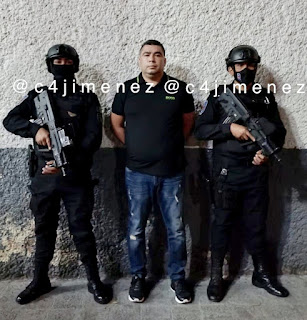
Federal and Mexico City forces captured José Alfredo “N” alias “El Contador”, regional leader of the Gulf Cartel-Ciclones-Scorpions branch in Tamaulipas.

The Mexican government reports that the subject is linked to the transfer of drugs and weapons, in addition to different acts of violence, in particular the murder of 15 people in Reynosa in June of last year.

The operation was carried out by the Mexican Army, the National Guard and the Secretariat of Citizen Security of Mexico City, with intelligence information from the National Intelligence Center (CNI).

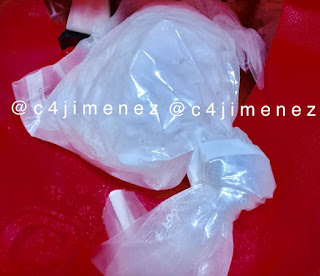
The alleged criminal was captured in Mexico City, with a .380 caliber firearm and 600 white packages, with characteristics of methamphetamine. He was placed at the disposal of the Mexico City Attorney General's Office.

"El Contador" has a valid arrest warrant in Tamaulipas and is subject to investigation for various crimes, says the federal government bulletin.

The alleged criminal is identified as José Alfredo Cárdenas Martínez. He was arrested within the Cuauhtémoc neighborhood in Mexico City.


Carlos Jiménez

Aristegui Noticias

San José de Gracia, Michoacán: Armed Attack At Wake Kills Several Civilians

"Sol Prendido" for Borderland Beat


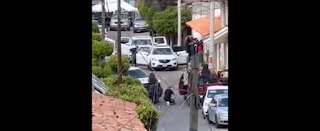
Banda music was playing at the celebration of a wake this Sunday afternoon in San José de Gracia, when suddenly at least two white vehicles stopped at the door, heavily armed men got out and shot at the relatives.

The armed criminal cell literally shot several civilians who were outside the home. There is talk of several deaths from this attack, preliminary versions - although not official - speak of 17.

A person recording from a nearby house was able to capture what happened on video, although the attack is not clearly visible, it is clearly seen how several trucks blocking the street, armed men dressed in tactical clothing are observed around the units.

Outside one of the homes, a dozen or more people can be seen against the wall of a house with a yellow facade, followed by several shots from a firearm with which they killed all those civilians. There is evidence of the sound of the gunfire and a cloud of dust and smoke that came out from the place of the wake. The news is already circulating on social networks.

These events already generated the mobilization of police forces, the National Guard, the Mexican Army and the Michoacán Prosecutor's Office.

More information is soon to follow. 


Primera Plana Mx

Ixtlahuacán, Colima: Criminals Abandon Dismembered Corpse In The Los Trabajadores Neighborhood

"Sol Prendido" for Borderland Beat


* They leave a narco message

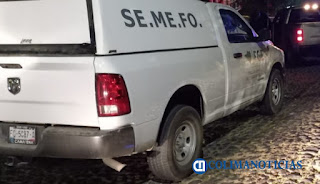
This morning the body of a dismembered man was located at the intersection of Colima Avenue and Madero in the Los Trabajadores de Colima neighborhood. 

Around 6:15 in the morning through the emergency center the authorities were informed about the event.

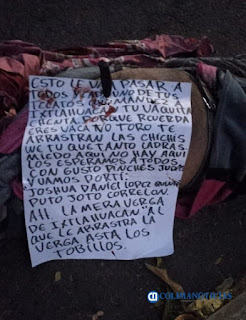
Later, the police corporations confirmed the facts, and discovered that there was also a cardboard with a drug message.

The Public Ministry agent ordered the removal of the human remains and the cardboard for the start of the investigation.

Narco massage reads as follows:

Vaquita Chenta, this will happen to everyone. Along with every meth head that you send to Ixtlahuacán. Don’t forget that you’re nothing more than a cow and not a bull. Your breasts are dragging on the ground. You, who’s always barking so much. We hold no fear here. 

We’re gonna wait with pleasure for you Judas Iscariots. We’re coming after you Joshua Daniel Lopez Quintero. You fucking retreating coward. Sincerely, The grand dick out of Ixtlahuacán. The one whose dick is dragging around his ankles. 

Colima Noticias

Seattle, Washington: "China And Mexico Are Flooding Our City Streets With Poison"

"Sol Prendido" for Borderland Beat


Fiercely addictive fentanyl-laced pills are flooding our communities and tearing families apart—driving the spikes in crime, homelessness and death. We hear from the feds who are fighting to kill the cartel smuggling business and raise awareness about this health crisis. 

Fox 13 Seattle

CDG Los Metros Destroy Surveillance Cameras in Series of Highly Coordinated Attacks in Reynosa and Ribereña

"Itzli" and "HEARST" for Borderland Beat 


Beginning the night of February 24, 2022, the government run video surveillance system in Reynosa, Tamaulipas has been under attack by members of the Los Metros faction of the Gulf Cartel.


Prelude to Destruction

On Thursday, February 24, 2022, which is Flag Day in Mexico, the Governor of the state of Tamaulipas Francisco García Cabeza de Vaca inaugurated a three day international forum called "Strengthening Police Capabilities 2022" at the state’s University of Security and Justice.

Chaos Continues In Colima: Seized House Set on fire; One Killed And Two Wounded

 "Ivan" for Borderland Beat 


The fire spread and presumably reached four other small neighboring houses.

In Colima, there are 7,789 members of the security forces, both federal, state and municipal, and even so there is chaos generated by organized crime.

In the context of the violence generated by the war, presumably between the Jalisco Nueva Generación and Los Mezcales cartels, this Saturday there has been a house on fire, a murder and two gunshot wounds in different neighborhoods of Colima capital.

Burnt house

A house that was secured a few days ago in Colima capital was set on fire, which caused other homes to be damaged.The event was recorded on 5 de Mayo and Sor Juana Inés de la Cruz streets, in the Fátima neighborhood, Colima, where two people were murdered on February 22.

This house is located in front of a school, where this Saturday, February 26, it was the locals who reported the fire. The fire spread and presumably reached four other small neighboring houses.

The place was attended by elements of Firefighters, Civil Protection as well as members of the armed forces, National Guard and State Police. According to the neighbors, they heard detonations of gun fire. 

"Motosicarios" commit murder

On the other hand, in the Nuevo Milenio II neighborhood, located in the eastern part of the capital of Colima, the murder of a man shot was reported.

According to the first reports, the subject was walking down Calle De los Andes when motorcycle gunmen shot him at close range.

This caused an intense police mobilization in the area, however no one was arrested.Two people shot and wounded

Later, in the Revolution neighborhood, also located in the eastern part of the capital Colima, armed individuals tried to assassinate two people. The attack occurred on Tecomán Avenue, a site where two men sustained gunshot wounds. The alleged perpetrators fled without being arrested. The elements of the Red Cross transferred the injured to receive urgent medical attention.

EL OCCIDENTAL

Saturday, February 26, 2022

Finally A Memorial For Those Dissolved By Acid In Tijuana

"Sol Prendido" for Borderland Beat

Push-back against early release of El Pozolero

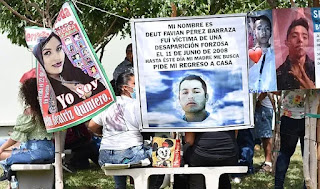
"My name is Deut Favian Perez Barraza. I was a victim of a forced disappearance June 11, 2008. Until today my mother looks for me. I ask for my return home."

February 4 marked the 13th anniversary of the detention of El Pozolero (Ignacio Meza), a construction worker who used acid to dissolve more than 300 bodies for the Arellano Felix Cartel in Tijuana. (Pozolero means someone who cooks pozole, a Mexican stew.)

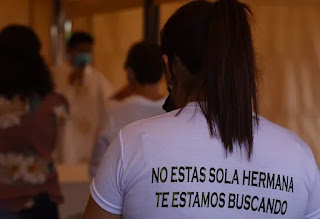
The collective Unidos por los Desaparecios de Baja California gathers in the lot called La Gallera, where they come to pray at a memorial for the missing.

They think there are more than the 300 victims the government says are buried here. Fernando Oceguera, the director of Unidos por los Desaparecidos, says that numbers could be up to 1200 bodies. Between 2006 and 2009, when the Arellano Felix’s Cartel controlled Tijuana’s drug trafficking El Pozolero was paid $600 USD weekly, according to authorities.

Oceguera’s son disappeared in 2007 when the federal government's war on drugs escalated and violence increased drastically. Although he hasn’t found his son, he’s not giving hope. Since then, Oceguera and other members of the collective had focusing their life looking for their loved ones, and the idea of doing a memorial in La Gallera will give thousands of families a place to pray.

“We had the chance to sensitize neighbors around about what happened in La Gallera end, they gave us permission to take care of the lot. “Without a body, we have no grave. For instance, in Dia de los Muertos they have no place to bring flowers, candles, or pray. That’s the idea.”

"You are not alone, sister. We are looking for you."

It was not until Oceguera reached out the Baja California’s governor at that time, Francisco Vega, who recognized them as the new owners of the lot.

“We had it to knock so many doors to get donations and make it real. Now with an investment of 3 million pesos (approximately $145,000), it’s becoming real.” This April the Victims Memorial will be official.

Oceguera argues that the crime committed in La Gallera is one of the most horrible atrocities in Mexico since the war on drugs policy started in 2006.

Last week Oceguera and the collective received information that El Pozolero could be released this year. He went to Mexico City to pressure the prosecutors office for organized crime not to let Santiago Meza's sentence be reduced. El Pozolero has still half of his sentence to complete.

San Diego Reader

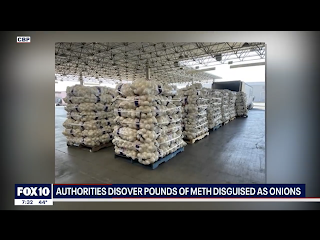
Otay Mesa, California: Authorities Discover Meth Disguised As Onions

"Sol Prendido" for Borderland Beat

Officials with the U.S. Customs and Border Protection say their officers found meth that was disguised as onions during a bust at a California border crossing. 

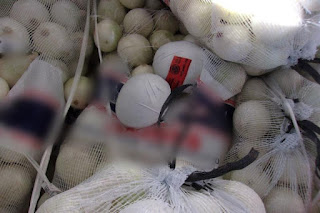
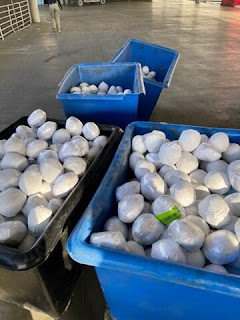
U.S. Customs and Border Protection officers at the Otay Mesa commercial facility discovered almost 1,200 small packages of methamphetamine hidden within a shipment of onions on Sunday. 

At approximately 1 p.m. on February 20, CBP officers encountered a 46-year-old driver of a tractor trailer with a shipment manifested as onions.  During the inspection, a CBP officer referred the driver along with the conveyance for a more intensive examination. 

During the exam, a CBP canine team screened the truck and trailer and the detector dog alerted to the shipment.  CBP officers searched the shipment and discovered 1,197 packages of methamphetamine mixed with the onions in sacks.  The packages of methamphetamine were shaped into small globes with a white covering, designed to blend into the onions they were hidden with.

CBP officers extracted approximately 1,336 pounds of methamphetamine worth an estimated street value of about $2.9 million. 

“This was not only a clever attempt to try and smuggle in narcotics, one I haven’t seen before, but also time consuming to wrap narcotics into these small packages, designed to look like onions,” said Sidney Aki, CBP Director of Field Operations in San Diego.

“These efforts show how effective our officers are, and as a response, the lengths drug trafficking organizations are willing to go to as they try to smuggle narcotics into the U.S.  While we have certainly seen narcotics in produce before, it’s unusual for us to see this level of detail in the concealment.” 

The driver was arrested for the alleged narcotic smuggling attempt.  

CBP officers turned the driver, a Mexican citizen, over to the custody of U.S. Immigration and Customs Enforcement (ICE), Homeland Security Investigations (HIS) for further disposition.

CBP officers seized the tractor, trailer, and narcotics.


cbp.gov

Fox 10 Phoenix

Commerce City, Colorado: Five Dead In Apartment Likely Overdosed On Fentanyl, DA Says

"Sol Prendido" for Borderland Beat


Prosecutor says victims were ingesting cocaine that they did not know was laced with the powerful opioid

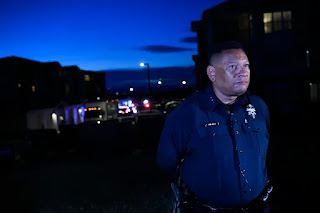
Commerce City police Chief Clint Nichols addresses the media to discuss the ongoing investigation of five deaths in an apartment at the North Range Crossings apartment complex at 14480 E. 104th Ave on Feb. 20, 2022 in Commerce City.

The five people who died inside a Commerce City apartment over the weekend likely overdosed unintentionally on fentanyl, 17th Judicial District Attorney Brian Mason said Monday.

Preliminary testing and other evidence suggest the five victims believed they were ingesting cocaine Sunday and did not realize the drug had been laced with fentanyl, Mason said. All five likely died almost instantly, he said.

The five deaths come as Colorado’s fentanyl overdose crisis continues to worsen and policymakers scramble to address the deadly opioid. An average of two Coloradans died of fentanyl overdoses every day in the first nine months of 2021, state data shows.

“No drug is safe,” Mason said. “Because any drug could literally have fentanyl in it without the user knowing. We’re finding it in cocaine, we’re finding it in heroin, we’re finding it meth. In limited cases, we’re even seeing it with marijuana.”

Commerce City police found the bodies of three women and two men around 3:45 p.m. Sunday inside a home at the North Range Crossings Apartments at 14480 E. 104th Ave. A 29-year-old woman and a 4-month-old infant were in the apartment but survived, Commerce City police Chief Clint Nichols said Sunday night.

The victims have not been publicly identified, but the women who died were ages 28, 29 and 32, police said, and the men were ages 32 and 24.

Mason warned that the tainted batch of drugs could still be circulating in the community.

“It is the nightmare scenario of the dangers of fentanyl,” he said. “…There are other people out there who might have drugs from that same batch or have drugs from the same dealer who could take those drugs tonight. And we have more deaths. It’s a terrifying public health, public safety crisis.”

Commerce City police are heading up the investigation into the deaths, along with the North Metro Drug Task Force and the district attorney’s office, Mason said. He declined to speculate on whether charges would be filed against the person who provided the drugs to the five victims.

Police said in a news release Monday that they were “aggressively pursuing leads” with plans to “vigorously pursue charges.”

“Obviously an investigation of this nature is very complicated,” Mason said. “There are five folks who are dead. We can’t interview them, ask them where the drugs came from, and that makes these cases very challenging. And quite honestly, the drug cartels know that when they are distributing these drugs.”

Mason said it was “miraculous” that one person survived the incident. He declined to say whether the survivor also ingested the tainted drugs, but said the person was rushed to a hospital for treatment.

Addiction resources

The Substance Abuse and Mental Health Services Administration runs a 24/7 hotline to help connect people to addiction services: 1-800-662-HELP (4357). People with substance use or mental health disorders can also contact Colorado Crisis Services at 1-844-493-8255 or text “TALK” to 38255.

Opioid overdoses, including fentanyl overdoses, can be reversed with naloxone, an over-the-counter nasal spray available at most pharmacies. 

Colorado nonprofits like Access Point Colorado (303-837-1501) and the Harm Reduction Action Center (303-572-7800) offer supplies like naloxone and fentanyl test strips. For a map of pharmacies that provide naloxone, check stoptheclockcolorado.org.

Denver residents can request fentanyl testing strips and naloxone from the Denver Department of Public Health & Environment via an online form.


Signs of an overdose include:
— Small pupils that look like a pinpoint
— Loss of consciousness
— Slow and shallow breathing
— Choking or gurgling sounds
— A limp body
— Pale, blue or cold skin

A next-door neighbor to the apartment, Ian Scott, told The Denver Post he was alerted to the deaths by the screams of a distraught woman who appeared high Sunday afternoon. Both the adult and the baby are expected to survive; it’s unclear if the baby’s parents were among the dead.

Fentanyl has been surging in Colorado for the last two years, Mason said, as drugmakers use the cheaper, more addictive option to boost their profits.


Preliminary data from the Colorado Department of Public Health and Environment shows that at least 767 people died of fentanyl overdoses in 2021, though deaths in the last three months are still being counted and the final number will be higher.

Approximately half of the 1,581 Colorado drug overdose deaths last year that have been recorded thus far involved fentanyl, the provisional data shows. Of those 1,581 people, 618 died of methamphetamine, 227 died of cocaine, 167 died of heroin and 55 of alcohol.

Even without full data for the last three months, the 2021 death toll is a 42% increase from the 540 deaths recorded in 2020. Colorado’s age-adjusted rate of fentanyl overdoses has increased fivefold from the rate of 1.7 per 100,000 people recorded in 2018 to 9.29 in 2020.

Final 2021 mortality data will be available in May, Kirk Bol, manager of CDPHE’s Vital Statistics Program, said in an email.

Colorado Attorney General Phil Weiser said Monday that the deaths in Commerce City show prosecutors and investigators need more resources in order to better address surging fentanyl use. He and Mason in December called for harsher penalties for people who sell fentanyl, and Weiser reiterated that stance, calling on lawmakers to create either a new charge or a sentence enhancer for people who sell drugs that result in the customer’s death.

Typically, the charge of distributing drugs resulting in death is easier to prove in court than a murder count, he said, though the specific elements and penalties would depend on how changes to the law are written. Weiser said he expects to see such a bill introduced this year.

“When you distribute drugs and it results in someone’s death and you are, essentially, on notice that you could be doing this, it’s not the same as when you distribute drugs and someone is feeding their addiction,” he said, adding that he does not want to see increased criminal penalties for people suffering from addiction.

It’s rare but not unheard of for drug dealers in Colorado to be charged with murder in connection to overdose deaths. In December 2020, a 25-year-old Aurora man was charged with first-degree murder after he was accused of knowingly giving fentanyl to a 16-year-old girl who then overdosed and died. That case is pending trial.

Another pending case is that of a 21-year-old Boulder County man who was charged with manslaughter in December after authorities there said he sold pills laced with fentanyl that resulted in a woman’s fatal overdose, Boulder’s Daily Camera newspaper reported.

And in 2014, a Centennial woman linked to four fatal overdoses was charged with first-degree murder in the 2011 overdose death of 21-year-old Carter Higdon. She pleaded guilty to second-degree murder and was sentenced to 18 years in prison.

Denver Post

Valenciana, Guanajuato: Cartel Jalisco Deny Having Abducted Missing Miners

"Sol Prendido" for Borderland Beat


The Jalisco New Generation Cartel (CJNG) distances itself from the miners who were abducted from the Santa Fé Mining Cooperative, they were allegedly kidnapped in Valenciana, Guanajuato. But the miners denied this version of events. 

Video translation is as follows:

This message goes out to the state of Guanajuato and its government. We do this so that all the citizens of Guanajuato realize how the government lies to them at all times. We the CJNG distance ourselves from those acts since our enterprise isn’t dedicated to kidnapping or extortion. Our company is dedicated only and exclusively to drug trafficking.

This is not how the state attorney's office has expressed it. In order to cover their activities in which they are involved or to make the people believe that they’re working. Keep doing the dumb shit you’re doing and eventually we’re going to fucking destroy you guys. Afterwards, don't be crying asking for a truce once you’ve felt those hits because you fucking cowards decide to bitch up. 

We’ve already purged this plaza of these gay ass filthy individuals who extort and kidnap. And now you seem to want this corridor. But instead you will now fuck yourselves. Because we’re a powerful and formal enterprise who will fight you faggots. You already know that the state of Guanajuato has an owner. And that’s Lord Mencho. Let it be made clear to you faggots that we didn’t kidnap those miners. 

This didn’t go down as you’re claiming. And you sure didn’t rescue them either. They reached their homes on their own. Just as well no money was asked for their release. Nor was this a kidnapping. The only thing you fucking faggots do is bring under the lives of innocent families. 

By hitting the drug points, assaulting the women and children, planting weapons and drugs on them, and stealing what little items those humble individuals have. You are all hereby advised that we’re going to fucking destroy you. It’s in your best interest to be prepared. For every safe house that you bust or every operative of ours that you mess with. We will kill off one of yours, be they State or Ministerial policemen. 

This due to the fact that you’re all a bunch of beggarly fucks. Let’s see if that faggot who commands over you comes out to defend you dumb asses. He who warns in advance isn’t a traitor. Bring your fight against us and not the lives of innocent families. Don’t forget that the family is to be respected. Don’t forget that you homos also have your family’s. In many ways you guys are like a watch in that everyday you tend to repeat the same actions. And we already have every one of you fags located. Sincerely, CJNG Grupo Elite. We are the absolute mob of Lord Mencho.

Balam.

112 Arrested In Secretary Of Citizen Security Raid In Iztapalapa, CDMX

 "Ivan" for Borderland Beat 

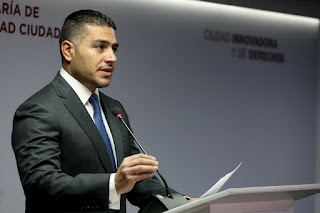
Omar García Harfuch, head of the SSC CDMX reported on the operations and arrests in Iztapalapa. 

Mexico City. The head of the capital police, Omar García Harfuch, said that in the last 48 hours, 112 people were arrested in various neighborhoods of Iztapalapa for their possible responsibility in various crimes, among which Ángel M, alias El Sapo or El Bala, identified by the Secretariat of Citizen Security (SSC) as one of the main generators of violence in the Tlalpan demarcation, in addition to being an operator of the Los Maceros criminal group.He announced that in the following days at least 900 elements of the local SSC will be deployed in the streets of Iztapalapa to reduce the criminal incidence as happened with the various actions last week in Cuauhtémoc. 

According to the investigations of the SSC, El Sapo or El Bala is located as one of the main operators of the Los Maceros criminal group, in addition to being dedicated to the purchase and sale of drugs, he is in charge of providing vehicles for illicit activities. Jesus Eduardo H, alias El Macero.

El Sapo or El Bala was arrested for the crimes of drug dealing and carrying a firearm for the exclusive use of the Army, on Calle Nueva Revolución 3 and Jacarandas in the El Vergel neighborhood, in Iztapalapa.

At a press conference, García Harfuch pointed out that the 112 detainees are possibly responsible for crimes against health, possession of a firearm, homicide, robbery from a passer-by, robbery of a home, robbery of a business with violence and vehicle theft, although He specified that 19 of them were identified as drug users.

He pointed out that a search warrant was carried out in a building located in the Ampliación María Aztahuacán neighborhood where around 40 tons of auto parts were seized.


La Jornada

@OHarfuch

Secretary Of Navy Captain Kidnapped And Released In Badiraguato, Sinaloa

"Ivan" for Borderland Beat 


Culiacán, Sin.- The municipal government of Badiraguato, headed by José Paz López Elenes, revealed another version of the events that occurred last Thursday in the Surutato area, where they reaffirm that, in effect, the illegal deprivation of liberty of an active element of the Secretary of the Navy by people allegedly from organized crime.

The statement details that minutes before 6 in the morning last Thursday, a group of 10 people left some cabins where they vacationed for more than a week, and when leaving the town, they would have been intercepted by heavily armed individuals who were traveling in vehicles whose characteristics were not disclosed.


The City Council explains that the probable criminals "kidnapped" the element of the Navy, but gave the rest of the group the opportunity to enter the mountain, so that they would not suffer the same fate; it would have been they themselves who gave notice to the municipal authority about what was happening. The Badiraguato City Council specifies that after conducting interviews with those involved, they found some impressions because there was a discrepancy between the versions of one and the other.

They also clarify that one of the three vehicles in which the vacationers were traveling, including the "kidnapped" sailor, presented some suspicious modifications, of the so-called "nails", which are spaces used to store items and are difficult to detect.

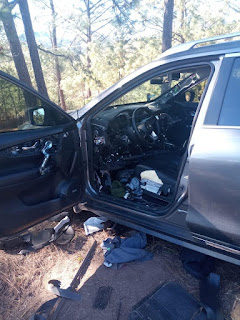
The governor of the state, Rubén Rocha Moya confirmed this Friday that the active element had already been released by his captors, without elaborating on details. The municipal government also provided photographs showing one of the dismantled vans.

LN