Blog dedicated to reporting on Mexican drug cartels
on the border line between the US and Mexico
.

Wednesday, April 6, 2011

Cartels in Baja California largely dismantled: General Alfonso Duarte

TIJUANA, BC. | Lunes 04 de abril de 2011
Julieta Martínez / corresponsal | El Universal


Six suspects were detained by the Mexican Army in Tijuana recently in two separate operations that resulted in the seizure of 658.62 kilograms of “crystal meth”, 75 kilograms of cocaine, 3.62 million pesos and almost 290 thousand U.S. dollars. The value of the drugs seized was estimated by the Army at approximately 16 million U.S. dollars

Speaking on this latest drug seizure in Tijuana, the commander of the Second Military Region (Baja California, Mexicali), Alfonso Duarte Mujica, explained that according to initial investigations, the six detained individuals operated independently since the criminal groups in Baja California belonging to the Arellano Felix and Sinaloa cartels have been greatly reduced.

"What is happening is that as the criminal cells that previously existed, those of the Arellano Felix and el Teo, have all been largely dismantled, and right now it is important that we continue working to maintain security and never again empower these cells and allow the problem to re-emerge,” said the general.

Duarte stressed that criminal groups recently arrested in his sector mostly operate independently and try to transport their drugs thru Tijuana because it is one of the busiest and most important regions on the border.

He attributed the violence that has occurred in recent weeks with criminal attempts by cells to maintain their "narcotiendas" (locations where illegal drugs are sold locally) in a free for all enviornment.

Duarte also stated that the increased seizures of cocaine and crystal are the results of greater efficiency in the actions of civil and military authorities. As a result of the financial losses criminals can no longer buy weapons, co-opt security officials or set up safe houses.

General Duarte is known as a particularly aggressive Army officer and last year shared with Julian Leyzaloa (who was Tjijuana’s municipal chief of police at the time) “Man of the Year” honors bestowed by the influential Baja California news weekly Zeta magazine.

source:
Ejercito detiene a seis.....
http://www.eluniversal.com.mx/notas/756746.html

Tuesday, April 5, 2011

Juarez violence claims life of 21 year old Colorado man


By Jeffry Wolf
9 News

The brutal violence terrorizing Mexican border towns hit home for a Colorado family Thursday. Armed commandos killed an Aurora man in Mexico Wednesday, according to the family and several Mexican media reports.

The murder happened in the northern Mexican border region, an area the U.S. State Department has urged Americans to avoid if possible because of ongoing cartel violence.

According to family members, Jake Marlowe Reyes-Neal was murdered in his own home early Wednesday morning. Suspected drug cartel gunman shot him up to eighty times with automatic weapons. According to the Mexican newspaper El Diario, 90 shell casings were found near the scene of the shooting outside Reyes-Neal's home in Ciudad Juarez.

"They kicked in the door," Matthew Reyes-Neal, the victim's brother, said. "He was protecting his family."

"They beat my cousin," Athena Bateman said. "They beat him in the house and dragged him outside and shot him."

"My nephew ran over and he said, 'Why is my Dad dead?'" Matthew Reyes-Neal said.

Jake Marlowe Reyes-Neal was just 21 years old. He moved his family to Mexico two years ago when his wife Tania was denied U.S. citizenship. According to family members, Tania's parents smuggled her to Colorado when she was a baby.

Jake and Tania met at Aurora Central High school when they were 16. They became high school sweethearts who fell in love, got married, and had a son named Anthony who is now 3. Jake Marlowe Reyes-Neal's wife and son survived the attack.

"He loved his son," Matthew Reyes-Neal said. "He loved his wife so much."

Jake Marlowe Reyes-Neal told family members he worried about the ongoing violence in Mexico.

"His worst fear was becoming a statistic. And that's what he became," Matthew Reyes-Neal said.

Police deny any role in disappearance of 4 men in Mexican tough cop’s border city

Human rights activists demand an outside investigation into the disappearance of four civilian men March 26 in the city, which has the highest drug-war death toll in Mexico.

In March, Lt. Col. Julian Leyzaola took the oath as secretary of public security of Ciudad Juarez, Mexico. (Alejandro Bringas / European Pressphoto Agency)

LA Times and AP

CIUDAD JUAREZ, Mexico — Rights activists and relatives of four men missing in this border city raised questions Monday about whether officers of the city’s new get-tough police chief were responsible for the men’s disappearance.

The city government said in a statement over the weekend that local police did not pick the men up and are not holding them.

At the center of the controversy is Ciudad Juarez’s new police chief, Julian Leyzaola, who was dogged by allegations that he inflicted or condoned torture during his previous tenure as top cop in another border city, Tijuana.

Government human rights inspector Gustavo de la Rosa said witnesses reported that the Ciudad Juarez men were last seen March 26, when they were picked up by patrol vehicles with decals matching those used by Leyzaola’s security detail.

“We have no proof that it was them (the security detail), but there must be an investigation into who was driving those vehicles, if it was not them,” de la Rosa said.

The city government said it would cooperate with any investigation by the appropriate authorities. In such cases, the responsibility for investigating falls to state prosecutors.

A spokesman for Leyzaola's department said it would cooperate in any investigation of the disappearances.

Armida Vazques, sister of two of the missing men, said her brothers were picked up outside a street market for no apparent cause.

“The only thing we want is for them to hand them over, we won’t press charges ... but we want them to returned,” said Vazques.

Mexican journalist, poet Javier Sicilia calls for popular uprising against violence on Wednesday

This is Mr. Sicilia's open letter to Mexico's politicians and criminals, in which he calls on all Mexican citizens to take to the streets to protest violence and corruption associated with the cartel drug wars. The writer's son, Juan Francisco, was murdered last week by criminals.

The brutal assassination of my son, Juan Francisco, of Julio César Romero Jaime, of Luis Antonio Romero Jaime, and of Gabriel Anejo Escalera, is added to so many other boys and girls who have been assassinated just the same throughout the country, not only because of the war unleashed by the government of Calderón against organized crime, but also the rotting of the heart that has been wrought by the poorly labeled political class and the criminal class, which has broken its own codes of honor.

I do not wish, in this letter, to speak with you about the virtues of my son, which were immense, nor of those of the other boys that I saw flourish at his side, studying, playing, loving, growing, to serve, like so many other boys, this country that you all have shamed.

Speaking of that doesn’t serve for anything more than to move what already moves the heart of the citizenry to indignation. Neither do I wish to talk about the pain of my family and the families of each one of the boys who were destroyed. There are not words for this pain. Only poetry can come close to it, and you do not know about poetry.

What I do wish to say to you today from these mutilated lives, from the pain that has not name because it is fruit of something that does not belong in nature – the death of a child is always unnatural and that’s why it has no name: I don’t know if it is orphan or widow, but it is simply and painfully nothing – from these, I repeat, mutilated lives, from this suffering, from the indignation that these deaths have provoked, it is simply that we have had it up to here (hasta la madre).

We have had it up to here with you, politicians – and when I say politicians I do not refer to any in particular, but, rather, a good part of you, including those who make up the political parties – because in your fight for power you have shamed the fabric of the nation.

Because in middle of this badly proposed, badly made, badly led war, of this war that has put the country in a state of emergency, you have been incapable – due to your cruelties, your fights, your miserable screaming, your struggle for power – of creating the consensus that the nation needs to find the unity without which this country will not be able to escape.

Video: "La Guera Loca" decapitates an alleged Zeta

This woman is called "La Guera Loca" be her companions. Although it is not confirmed, they are presumably Gulf Cartel members.

Several narco blogs have recently released a video showing a young blond haired woman decapitating a man whose head and hands are bound with what appears to be duct tape.

It is unknown where and when the 14 minute video was made.

During the video you can hear unidentified men advise the woman on how to perform the beheading, as well as their concerns that the event be documented properly on video.

As the woman continues severing the victim's head with a machete, you can hear an unidentified man refer to her as "La Guera Loca" (the crazy blond), another man says "This is what happens to those who help the Zetas".

After the woman finishes the decapitation and briefly poses with the head as a trophy, others begin to dismember the victim's body and skin the face and skull.

CAUTION: EXTREMELY GRAPHIC VIDEO

Mexico sets rewards for reporting money laundering

AP

Mexico announced a plan Monday to reward people who report suspected money laundering, under a program that will allow them to get up to one-quarter of any illicit funds or property seized.

Mexico has struggled to find effective measures to combat a flood of about $10 billion a year in suspicious cash flows possibly linked to drug trafficking.

Under the new plan, people can file reports in person, by telephone or by e-mail. The exact percentage of individual rewards will be determined case by case by a special committee.

Public servants, law enforcement and banking system employees will not be eligible for the rewards, in part because it is already their duty to report suspicious transactions.

Catching money launderers in Mexico is difficult because of loose regulation, a largely cash-based economy, an influx of legal dollars from remittances and other sources, and the increasing sophistication of drug cartels that move proceeds from U.S. and domestic drug sales across borders.

In August, President Felipe Calderon proposed tough new anti-money laundering rules to bar cash purchases of any real estate in pesos and cash purchases of cars, planes and other goods for amounts exceeding 100,000 pesos ($7,700). The measure is still being considered in Congress.

In June, the government imposed its strictest limits ever on transactions in U.S. dollars, limiting tourists and residents who don't have accounts at Mexican banks to dollar transactions of $1,500 a month or less.

Aspiring California pro fighter among 2 fatally shot at San Ysidro border crossing

by Sandra Dibble

Sign On San Diego

In a rare shooting at the San Ysidro border crossing, two San Diego workers were killed early Monday as they sat in a pickup waiting to enter the U.S. The men were on their way to work when someone shot them repeatedly with a 9 mm weapon.

The Baja California Attorney General’s Office identified the victims as Kevin Joel Romero, 28, and Sergio Salcido Luna, 25. The agency provided few details of the incident, which occurred at about 2:40 a.m., a time when many workers are in line to cross.

The men’s employer said they lived in Tijuana and worked for West Coast Beverage Maintenance, a company on Morena Boulevard that services and cleans draft beer equipment for bars and restaurants.

Matt Pelot, the company’s owner, said Romero and Salcido had worked for him for about 1 1/2 years. He said both were U.S. citizens who lived in Mexico to keep down expenses.

“They were good guys,” Pelot said. “I don’t think they were dealing drugs, selling drugs or anything to do with drugs. They were both very hardworking individuals. They had a zest for life.”

A Mexican law-enforcement source said the two men apparently were targeted by an assailant who approached on foot between the lines of vehicles, fired his weapon and fled. The Attorney General’s Office statement said that they had been shot in the head, chest, and arms.

Attorney General Rommel Moreno Manjarrez told reporters that detectives were investigating the possibility that the incident could be drug related. He said one of the victims – he did not say which one – had a “small packet of drugs among his belongings.”

Neither U.S. nor Mexican officials immediately confirmed the men’s nationality Monday. But a U.S. law-enforcement source said that it appeared that neither had criminal records.

Pelot said the men were friends who would cross early, as many workers do, and take a nap before showing up for work. Both worked out in gyms and were clean cut.

The younger of the two, Salcido, was a cage fighter – a form of martial arts – who was training for a fight in June. Romero was in the process of adopting his girlfriend’s 5-year-old son. “They worked real hard and wanted to pick up as much overtime as possible,” Pelot said.

More than 24 million people crossed in personal vehicles last fiscal year at the San Ysidro border crossing, according to Customs and Border Protection.

Shootings in the border crossing lanes are extremely rare. In January 2002, a Mexican soldier sprayed bullets into cars waiting in line on the Mexican side of the Otay Mesa border crossing, wounding three people. In April 1995, a stray bullet from a police shootout hit an innocent Mexican motorist in the head as he was waiting in line to cross into the United States, killing him instantly.

McCaul Chairs Hearing to Develop Strategy to Defeat Mexican Drug Cartels

Citing the United States’ present approach as “failing”, Congressman Michael McCaul (R-TX) called on multiple cabinet level agencies to develop a new, cohesive strategy to help the Mexican government combat the drug cartels that have taken over much of Mexico and that pose an increasing threat to both nations.

“The fundamental question of this hearing is ‘what is our strategy down there?’”, said Rep. McCaul at the Homeland Security Oversight, Investigations and Management Subcommittee hearing, which he chaired. “It is time for the United States to take decisive action.”

“We need to act now because it is a crisis. We cannot afford for Mexico to become a failed state overtaken by these drug cartels where terrorists could operate out of.”

In the latest effort, the 2008 Merida Initiative, Congress approved $1.3 billion in military resources for the Mexican government. To date, however, the State Department has allocated only one-quarter of the funding and the violence has escalated.

Luis Alvarez, Assistant Director of Immigration and Customs Enforcement, described the level of cooperation with the Mexican government as “excellent”. However, he testified that the increased threat to US law enforcement, highlighted by the recent murder of ICE Special Agent Jaime Zapata, has put a chilling effect on his agency’s efforts.

“One of the problems that we face now is trying to recruit ICE agents to actually go down to Mexico and work on our behalf. It’s getting more and more difficult as a result of the increased violence,” Alvarez said.

As part of a new strategy, Congressman McCaul has introduced legislation to designate Mexican drug cartels as Foreign Terror Organizations. This designation would allow the United States to limit cartels’ financial, property and travel interests, and to impose harsher punishment on anyone who provides material support tocartels.

The cartels have killed more than 35,000 people in Mexico in five years employing gruesome tactics and in the past year have increased the number of assassinations and murders of high profile Mexican officials in efforts to intimidate and control.

“It’s going beyond just a criminal enterprise,” Rep. McCaul said. “They actively affect the political, judicial and law enforcement systems in Mexico to gain political and economic influence.”

“We’ve got to get out of this mindset where we are only dealing with the phased fanatic that is a suicide bomber screaming “Allahu Akbar!” agreed Jon Adler, president of the Federal Law Enforcement Officers Association. “We need to call it for what it is. And we need to respond accordingly. I completely support you on that,” Adler testified.

Congressman McCaul has further proposed examining successful tactics used in Plan Colombia, a joint military and intelligence operation,which helped undermine that country’s drug cartels and restore its national and economic security.

“We could work jointly in a military fashion as partners. We have the capability to wipe out these drug cartels if we have the leadership to do it,” Rep. McCaul said.

Today’s was the first of a two-part hearing. Congressman McCaul plans a second hearing in April to focus on efforts on the US side of the border.

Urban warfare erupts in Acapulco

A clash between security forces and gunmen in the early morning hours of Monday resulted in 3 fatalities and a commercial area in ruins in the metropolitan area of this troubled tourist destination.

The fatalities included 2 gunmen and a Mexican Army soldier. The fighting also left 2 policemen, a soldier and an innocent bystander injured. 7 Gunmen, including 2 with gunshot wounds were apprehended.

The incident began at 4:30am in the Colonia Emiliano Zapata area when, according to authorities, a Joint Urban Operations patrol surprised a large group of gunmen in the commercial zone. (The joint operations unit, known in Spanish by its acronym, BOMU, consists of military troops and federal and state police officers formed to combat warring organized criminal gangs in Acapulco).

Gunfire was exchanged between the BOMU unit and the gunmen for more than an hour during which the fighting spread to the Ciudad Renacimiento area. Grenade explosions were also reported by neighbors and witnesses.
During the fighting in the commercial zone a fire erupted that engulfed and destroyed the Acatianguis market complex, destroying up to a hundred stalls and a neighboring Comercial Mexicana installation and warehouse in addition to several parked cars.

Both buildings and their inventory were destroyed and the economic loss was reported to be considerable.

According to a source in the Secretariat of Public Security and Civil Protection (SSPPC), the confrontation between gunmen and the BOMU unit occurred when the gunmen, who were travelling in at least 3 vehicles were intercepted while they were in the process of setting fire to the Acatianguis market complex.

The market complex was being disputed by rival ciminal gangs and was reported to be a lucrative source of income where hundreds of merchants were forced to pay extortion “cuotas”, or fees..

The fire was put out by firefighters from the municipality of Buenos Aires by 7am.

Three vehicles belonging to the gunmen and an undetermined numbers were seized. Also seized were several bulletproof vests marked with the initials “FEMK”.

According to a state SSP official, “FEMK” means "Fuerzas Especiales de Melón y Koreano”, or "Special Forces of Melon and Koreano”.

Melon and Koreano are the aliases used by 2 cell leaders belonging to the Cártel Independiente de Acapulco (Cida), or the Independent cartel of Acapulco. This criminal group is fighting for the Acapulco “plaza” against bands of criminals led by Heber Jair Sosa Carvajal “El Cremas” and Cristian Hernández Tarín.


Earlier Monday morning, at approximately 1:00am, two human heads were located on Avenida Escenica not far from a burning Volkswagon sedan. Authorities responding to the crime scene reported that the bodies of the victims were missing.


Dan Rather Reports, Excerpt from Mexican Standoff

Jorge Castañeda Gutman is a Mexican politician and academic who served as Secretary of Foreign Affairs (left) and talks about legalization of drugs.

We've all read the newspapers and seen the headline surrounding the bloody drug war in Mexico. The death toll soars as the United States backs Mexico's war on drug trafficking and tensions between the two governments threaten to fray this vital partnership.

So far, 34,000 Mexicans have been killed and now the drug cartels have expanded their reach from beyond the borders into all parts of the country.

Anxiety is high and many are saying it's time for a radical re think.

The 2006 election of President Calderon signaled a new cooperation. Calderon deployed his nation's military against the drug cartels who in recent years have grown into vicious criminal gangs. But some are saying what's being done now isn't enough.

In this special Dan Rather Reports, we travel to Mexico City to meet with top experts and observers to find out what is happening behind the scenes and what the future of Mexico holds.

Monday, April 4, 2011

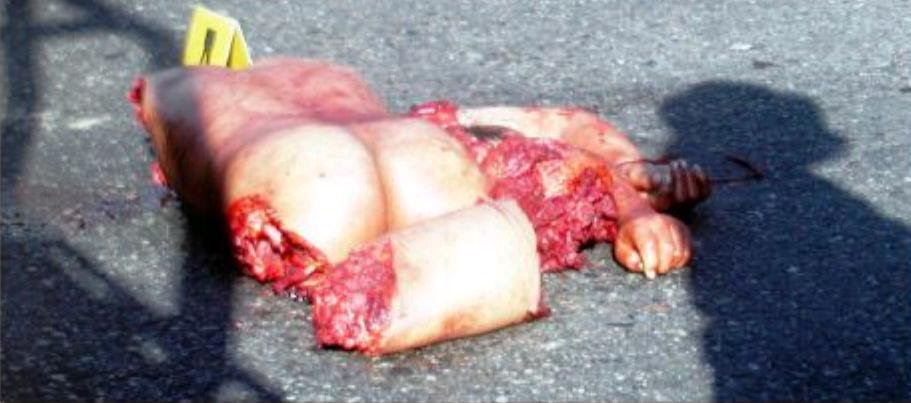
A Juvenile is Dismembered in Acapulco, Guerrero


In Acapulco the violence has seen a drastic increase in recent months, clashes, executions, and gory discoveries are some of the events that that society has been witness to.

During the afternoon last Friday authorities were called to the community of La Cima, almost at the front door steps of Azteca bank, the remains of a dismembered body were found scattered on the ground. The hands and torso were found butchered in pieces.

The Mexican military and Federal Police provided security while forensic police investigators processed the scene.

It appeared to be a young man between the ages of 13 and 15 who had been shot and butchered, and the gory cruel scene was witnessed by hundreds of onlookers.

A few minutes later police officers were called to the community of Loma Bonita where they found the head, legs and feet of the boy. The boy had been abducted by armed men.

Forensic police investigators were also present to process the crime scene and remove the remains. There was no information if a narco-message was left at the scene, but based on media reports, it did not appear. Authorities have no information on suspects or motive.

Six Officers are Executed in Veracruz and left with a Narco-Message

Mexican authorities confirmed that they found six police officers executed, among them a woman, in a village called Vega del Paso, based in El Higo, Veracruz. Authorities said that the officers were attack by sicarios armed with assault weapons type AK-47s.

Mexican military provided protection while police conducted their initial investigations and removed the bodies.

According to official reports the officers executed were identified as Fernando Alonso Cisneros, commander of police and of 31 years of age, Zulema Castillo Fernandez, 33, Armando Tenorio Ayala, 49, Orlando González Aguilera, 45, Leonel Ruiz Pérez, 25, and David de la Rosa Reyes, 23.

Along the dead officers there was a patrol car with a narco-message inside saying; "traitors."

The Government Secretariat said that preliminary investigations suggest that the organized criminal group that slaughtered the officers is believed to be from the state of San Luis Potosi.

The Southwest Border Is Open for Business

By: Janet Napolitano and Gary Locke
El Paso now has one of the lowest crime rates among big American cities.

Over the last few weeks, mayors, sheriffs, business leaders and citizens have joined together with a simple but powerful message: America's Southwest border communities are open for business. This is a message the American people need to hear.

Unfortunately, there is a widespread misperception that the Southwest is wracked by violence spilling over from Mexico's ongoing drug war. The facts tell a different story. Some of America's safest communities are in the Southwest border region, with crime rates in cities along the border staying steady or dropping over the past decade. For example, the crime rate in Tucson, Ariz., fell 15% between 2008 and 2009 and 21% in Brownsville, Texas, over the same period.


In the last two years, the Obama administration has made historic deployments of manpower, technology and infrastructure to help secure our Southwest border. These efforts—along with the heroic work of our Border Patrol agents—are paying off.

Between fiscal years 2009 and 2010, U.S. Customs and Border Protection and U.S. Immigration and Customs Enforcement seized 81% more currency, 25% more drugs, and 47% more weapons along the Southwest border than they did between fiscal years 2007 and 2008. Border Patrol apprehensions of illegal aliens—the best indicator of illegal immigration—have dropped by 36% over the past two years to less than a third of its all-time high.

Mexico: Thousands Missing in Drug War says CNDH

BBC
A Mexican human rights organization says thousands of people have disappeared in Mexico since 2006.

Mexico's human rights commission, CNDH, said 5,397 people had been reported missing since President Felipe Calderon declared war on the drug cartels.

A United Nations study has suggested the security forces may have played a part in the disappearance of some of those missing.

Mr Calderon has deployed 50,000 troops as part of his war on the cartels.

The CNDH collated data provided by relatives and by state authorities and included all of those "reported missing or absent".

The commission said 3,457 of those disappeared were men and 1,885 women, while there was no data on the remaining 55 cases.

The CNDH said it was investigating the reasons behind the disappearances, and stated that the figure included those kidnapped for ransom and economic migrants from within Mexico and Central America whose whereabouts were unknown.

The figures were released just days after the United Nations Working Group on Enforced or Involuntary Disappearances said it had received reports of several cases of forced disappearances allegedly carried out by Mexican soldiers.

The UN group urged the Mexican government to stop using the army in drug operations.

President Calderon deployed the army in an effort to curb the violence perpetrated by the country's drug cartels in which more than 34,000 have been killed since he took office.

Federal Police go after Los Zetas in Zacatecas


The February 7th, 2011 edition of the Proceso weekly news magazine included an article on the takeover of organized crime in the state of Zacatecas by Los Zetas and the impunity with which they operate in that arid central highland territory.

One of the startling revelations that highlighted that impunity was that of the Christmas “fiesta de posada” (a traditional Mexican Christmas celebration) sponsored and attended openly by the head of the Los Zetas criminal organization, Heriberto Lazcano Lazacano “el Lazca”.

The celebration was held in a hall seating 2,000 people in the municipality of Calera de Victor Rosales which borders the state capitol also named Zacatecas. Calera was reportedly cordoned off by Zeta gunmen during the festivities which had been announced by word of mouth and was attended by residents from surrounding municipalities.

During the festivities Lazcano was said to have personally handed out “aguinaldos” (a year end bonus of one month’s extra pay) to attendees of the fiesta.

On Sunday, March 3rd, Calera was the scene of a different type of fiesta.

This time it was Mexico’s Federal Police that mounted a major operation in the municipality that included approximately 300 officers, armored personnel carriers and up to 4 Blackhawk helicopters.

Sources within the SSP, the ministry that oversees the Federal Police, stated that the operation was the result of intelligence gathered by Mexico’s organized crime task force known as Siedo.

The operation was also a show of strength by Mexico’s latest Attorney General, Marisela Morales, the previous head of Siedo, who was appointed to the post after the resignation of Arturo Chavez Chavez.

Previously identified safehouses were raided and 12 alleged members of Los Zetas were taken into custody and flown to Mexico City.

According to media reports no shots were fired during the operation which lasted through the late afternoon.

It is not believed that Heriberto Lazcano was detained during the operation although it was reported that among those arrested was an unidentified high ranking member of Los Zetas.

Sources:
Capturan federales en Calera a 12 sujetos
http://ntrzacatecas.com/noticias/principales/2011/04/02/impresiona-el-despliegue-de-agentes-federales-en-zacatecas-2/
“Los Zetas” muestran el musculo
http://www.proceso.com.mx/rv/modHome/pdfExclusiva/88165
Photography courtesy of Osvaldo Martinez at zacatecasonline.com.mx
http://zacatecasonline.com.mx/index.php/noticias/policia/12071-toman-calera-400-policias-federales-en-operativo-contra-crimen-organizado