

Monterrey Sin Ley
Enrique Mendoza Hernández
Semanario ZETA
http://www.zetatijuana.com/2011/07/18/monterrey-sin-ley/

The mass killings in bars are no longer exclusive to Ciudad Juárez or Tamaulipas. Now the massacres also occur in Monterrey as seen at the El Sabino Gordo bar when 21 persons were executed on a Friday night, July 8th. .
The official version was predictable. According to Jorge Domene Zambrano, the Nuevo Leon State Security spokesman, “Until now the most likely motive was an attack by a rival gang because this bar had been identified as a drug selling point controlled by another group.”
Then, in a 24 hour period between July 11th and 12th, 18 people were killed in Nuevo Leon, including 2 fifteen year olds.
The next day, July 13th, another 5 victims were executed in Nuevo Leon, including another 2 teenagers.
What overshadows all the murders in Nuevo Leon is the lack of any investigation by the authorities, based on the official version that all the victims are linked to organized crime.
"I find it very troubling that when people are killed the official version by the authorities is that they are all criminals. This is serious because then the authorities believe there is no need to investigate”, says Sister Consuelo Morales Elizondo, Director of the NGO Citizens in Support of Human Rights in Monterrey, Nuevo Leon.
“There are a some bars like Sabino Gordo that was attacked last week where it is common knowledge that drugs are sold, so the question is why the authorities have not acted?"
"I do not believe the official version that everyone inside the bar was a ‘narcomenudista’ (street level drug pusher) but if a conflict of interest between members of organized crime at any given time can generate these massacres and the authorities are aware of this information, then the question remains. Why don’t the authorities act to prevent such painful situations that are taking us to a world of terrible inhumanity?”
The practice of criminalizing victims of violence comes from the top down as when President Felipe Calderon called the 15 adolescent and young students shot dead in Ciudad Juarez on January 31, 2010, “gang members”.
Lacking the ability to investigate and react, state authorities have continued the same practice of criminalizing victims, according to Sister Morales.
Sister Morales reminisces, "Last year, in March, a couple, Rocio Elias Garza and Juan Carlos Pena Chavarria, was killed after leaving their job in Anahuac, Nuevo Leon. State officials issued a statement, which they later retracted, that an extremely dangerous criminal called “La Gata” (the cat) had been caught.”
“The community of Anahuac was outraged when they realized what the authorities had said. According to the community the couple was leaving work to pick up their children at a daycare. That is when we started to realize the lies with which the authorities operate. It is unjust that we are criminalized to cover-up the failures of the authorities, and as this continues impunity continues to grow.”
“And as impunity grows, the executions continue to rise.”

Executions in Nuevo Leon have doubled.
Shootouts in downtown Monterrey, “narco” blockades, “narco” banners, “narco” fosas (clandestine gravesites), kidnappings, executions, extortions and police pursuits are the daily bread of residents living in the Monterrey metropolitan area, whose 4 million people comprise the bulk of the state population.
In the past four and a half years and according to information from Nuevo Leon’s Attorney General (PGJE) and the Federal Public Security Secretariat (SSP), Nuevo Leon has documented at least 2,443 murders linked to organized crime.
In 2007 Nuevo Leon counted 283 drug murders; in 2008 the count was 263; in 2009 it was 267; in 2010 the count jumped to 770; and up to June 30 of 2011 the count has more than doubled to 860.
The 2,443 murders rank Nuevo León as the fifth most violent state in Mexico. First thru fourth are Chihuahua with 11,264; Sinaloa with 6,055; Baja California with 3,072; and Durango with 2,800.
According to the PGR, "the phenomenon of increasing violence Nuevo León is explained by the clash between the Gulf Cartel and the 'Zetas' that has led to an increase in the number of murders since 2010".

No official statistics on the disappeared.
The violence in Nuevo Leon also includes many “disappeared, or missing, persons. Unfortunately the government of Rodrigo Medina, Governor of Nuevo Leon, does not provide statistics for missing persons in the state.
"A phenomenon that is of great concern are the disappearances where the young are being abducted, now even young girls are being taken.” Sister Morales responds.
“But this is not just about crime. We are also living with the anxiety of the military and Marines now patrolling all the neighborhoods as an answer for the protection of the citizens. The media portrays this as something very helpful but the reality is that this we are now receiving cases that tell us this is not the real picture.”
“For example, in Sabinas Hidalgo, in the last fifteen or twenty days, the Marines have taken more than 10 young people, including women and also a 54 year old woman and we can’t get any answers about them. We have gotten an injunction and the same Marines tell us they don’t have them.”
“We are really very concerned that institutions like the Navy, the military, SEDENA (the Ministry of Defence), are not even be able to tell the truth. We know they were Marines, soldiers, the parents know because some were taken out of their homes, and still they tell us it’s not true. We are in a serious situation, we are looking for all the people who have been taken without any help from the authorities."
Sister Morales says that the state authorities are not gathering any statistics of the disappeared in Nuevo Leon and the only quantifiable evidence is derived witness and relative’s testimony. "We have information from the same families who have been to the military searching for the disappeared that up to 20 complaints are being received daily.”
"A statement from SEDENA issued on Tamaulipas and Nuevo Leon spoke of 1,700 disappearances. The report was posted for a short while and then removed. There are people searching for the disappeared who are denouncing the Marines and public prosecutors who do not register with us and the majority of the people don’t denounce anyone because they are too paralyzed by fear.”
The human rights advocate claims that the Attorney General of Nuevo Leon, Adrian de la Garza, does not follow through in the investigations. "Eight people testified before the Movement for Peace with Justice and Dignity, headed by Javier Sicilia, about cases of missing persons in Nuevo Leon. It was decided to highlight these cases with the Attorney General, Adrian de la Garza.”
“De la Garza received the families of victims of the disappeared who told him they had reported the cases to the authorities and nothing has happened, and in some cases they had even been threatened."
"The Attorney General promised to have results within a month. So on June 7 De la Garza said he would have the status of the cases by July 7th."
At the time Sister Morales regretted the failure of any investigation by the Attorney General’s office, saying “90 to 95 percent of what's in those files is information collected by the same families of the missing."
The ZETA staff requested an interview with Attorney General Adrian de la Garza and Governor Rodrigo Medina. As of July 14 no response had been received to the request nor the status of the cases.
Meanwhile, the consequences of insecurity are made clearly visible in the closure of businesses in the state of Nuevo Leon.

928 firms close.
In addition to the families of victims of violence in Nuevo León reflected in the doubling of the murder rate from 2010 to the first half of 2011 plus the thousands of missing people, Nuevo Leon is also being affected by employers that are going out of business due to the insecurity. .
The Instituto Mexicano del Seguro Social (IMSS) counts the number of companies of all sizes that generate formal employment and who are enrolled with the institute. The highest number of companies registered with the IMSS in the state of Nuevo Leon is 58,418 counted on October 31, 2008, while the lowest number of employers counted since was 56,926 counted in January 2010.
At the end of the first half of 2011, on June 4th, the number of employers stood at 57,490 according to the IMSS regional office in Monterrey. Taking into account the highest number of companies registered with the IMSS on October 31, 2008, this means 928 businesses have closed.

Nobody wants to be police officer in Nuevo Leon.
In Nuevo Leon nobody wants to be a policeman. After the assassination of the mayor of Santiago, Edelmiro Cavazos Leal, which occurred on August 18, 2010, Juan Ernesto Sandoval, President of the National Chamber of Commerce, Services and Tourism (CANACO) in Monterrey addressed the reduction of police forces in the state.
"Right now there are no police in some municipalities. In Santiago where they killed the mayor (Edelmiro Cavazos Leal), when the mayor took office the town had 120 police officers and right now I think there are 7. Many have been killed, others left due to fear or threats and some have been removed for being linked with organized crime."
Governor Rodrigo Medina reacted a year later by acknowledging that he needed a lot of police and was implementing a plan to recruit them from other states and bring them to Nuevo Leon because the residents of the state do not want to work in the municipal or state departments of public safety.
“Because of the situation that we are living in we are going out to other entities, we have crews in other states that have been recruiting and are working on all fronts,” boasted the Governor without providing statistics on how many positions need to be filled or how many police officers had been recruited in other states, mainly in the south.
"I prefer to reserve the data but the call has been answered in other states," Medina said to the media last May 7.
"It is a serious situation, but more important than a deficit in police numbers I think there is a deficit in the system of policing. We have been unable to develop a police model that can tackle the public safety issue for the citizens of the state,” declared Sister Morales.
But while the Nuevo Leon police leave their posts the Governor is not far behind and prefers the strategy of "every man for himself" as he has fled his state and moved to McAllen, Texas.
"It's a shame that our governor when he took office that said he would give his life for the people of Nuevo Leon and, well, that's the way he’s giving it, by going to live in the U.S. It sad because our Governor should be willing to suffer the same fate as the citizens," laments Sister Morales.
Rodrigo Medina de la Cruz vowed on Wednesday, September 1, 2010 that he would "regain the tranquility and peace at any cost."
But three months short of his second year in office his words have not translated into deeds.
Enrique Mendoza Hernández
Semanario ZETA
http://www.zetatijuana.com/2011/07/18/monterrey-sin-ley/

The mass killings in bars are no longer exclusive to Ciudad Juárez or Tamaulipas. Now the massacres also occur in Monterrey as seen at the El Sabino Gordo bar when 21 persons were executed on a Friday night, July 8th. .
The official version was predictable. According to Jorge Domene Zambrano, the Nuevo Leon State Security spokesman, “Until now the most likely motive was an attack by a rival gang because this bar had been identified as a drug selling point controlled by another group.”
Then, in a 24 hour period between July 11th and 12th, 18 people were killed in Nuevo Leon, including 2 fifteen year olds.
The next day, July 13th, another 5 victims were executed in Nuevo Leon, including another 2 teenagers.
What overshadows all the murders in Nuevo Leon is the lack of any investigation by the authorities, based on the official version that all the victims are linked to organized crime.
"I find it very troubling that when people are killed the official version by the authorities is that they are all criminals. This is serious because then the authorities believe there is no need to investigate”, says Sister Consuelo Morales Elizondo, Director of the NGO Citizens in Support of Human Rights in Monterrey, Nuevo Leon.
“There are a some bars like Sabino Gordo that was attacked last week where it is common knowledge that drugs are sold, so the question is why the authorities have not acted?"
"I do not believe the official version that everyone inside the bar was a ‘narcomenudista’ (street level drug pusher) but if a conflict of interest between members of organized crime at any given time can generate these massacres and the authorities are aware of this information, then the question remains. Why don’t the authorities act to prevent such painful situations that are taking us to a world of terrible inhumanity?”
The practice of criminalizing victims of violence comes from the top down as when President Felipe Calderon called the 15 adolescent and young students shot dead in Ciudad Juarez on January 31, 2010, “gang members”.
Lacking the ability to investigate and react, state authorities have continued the same practice of criminalizing victims, according to Sister Morales.
Sister Morales reminisces, "Last year, in March, a couple, Rocio Elias Garza and Juan Carlos Pena Chavarria, was killed after leaving their job in Anahuac, Nuevo Leon. State officials issued a statement, which they later retracted, that an extremely dangerous criminal called “La Gata” (the cat) had been caught.”
“The community of Anahuac was outraged when they realized what the authorities had said. According to the community the couple was leaving work to pick up their children at a daycare. That is when we started to realize the lies with which the authorities operate. It is unjust that we are criminalized to cover-up the failures of the authorities, and as this continues impunity continues to grow.”
“And as impunity grows, the executions continue to rise.”

Executions in Nuevo Leon have doubled.
Shootouts in downtown Monterrey, “narco” blockades, “narco” banners, “narco” fosas (clandestine gravesites), kidnappings, executions, extortions and police pursuits are the daily bread of residents living in the Monterrey metropolitan area, whose 4 million people comprise the bulk of the state population.
In the past four and a half years and according to information from Nuevo Leon’s Attorney General (PGJE) and the Federal Public Security Secretariat (SSP), Nuevo Leon has documented at least 2,443 murders linked to organized crime.
In 2007 Nuevo Leon counted 283 drug murders; in 2008 the count was 263; in 2009 it was 267; in 2010 the count jumped to 770; and up to June 30 of 2011 the count has more than doubled to 860.
The 2,443 murders rank Nuevo León as the fifth most violent state in Mexico. First thru fourth are Chihuahua with 11,264; Sinaloa with 6,055; Baja California with 3,072; and Durango with 2,800.
According to the PGR, "the phenomenon of increasing violence Nuevo León is explained by the clash between the Gulf Cartel and the 'Zetas' that has led to an increase in the number of murders since 2010".
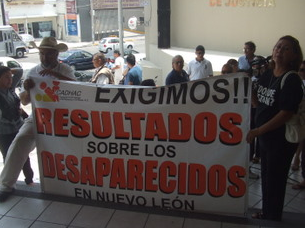
No official statistics on the disappeared.
The violence in Nuevo Leon also includes many “disappeared, or missing, persons. Unfortunately the government of Rodrigo Medina, Governor of Nuevo Leon, does not provide statistics for missing persons in the state.
"A phenomenon that is of great concern are the disappearances where the young are being abducted, now even young girls are being taken.” Sister Morales responds.
“But this is not just about crime. We are also living with the anxiety of the military and Marines now patrolling all the neighborhoods as an answer for the protection of the citizens. The media portrays this as something very helpful but the reality is that this we are now receiving cases that tell us this is not the real picture.”
“For example, in Sabinas Hidalgo, in the last fifteen or twenty days, the Marines have taken more than 10 young people, including women and also a 54 year old woman and we can’t get any answers about them. We have gotten an injunction and the same Marines tell us they don’t have them.”
“We are really very concerned that institutions like the Navy, the military, SEDENA (the Ministry of Defence), are not even be able to tell the truth. We know they were Marines, soldiers, the parents know because some were taken out of their homes, and still they tell us it’s not true. We are in a serious situation, we are looking for all the people who have been taken without any help from the authorities."
Sister Morales says that the state authorities are not gathering any statistics of the disappeared in Nuevo Leon and the only quantifiable evidence is derived witness and relative’s testimony. "We have information from the same families who have been to the military searching for the disappeared that up to 20 complaints are being received daily.”
"A statement from SEDENA issued on Tamaulipas and Nuevo Leon spoke of 1,700 disappearances. The report was posted for a short while and then removed. There are people searching for the disappeared who are denouncing the Marines and public prosecutors who do not register with us and the majority of the people don’t denounce anyone because they are too paralyzed by fear.”
The human rights advocate claims that the Attorney General of Nuevo Leon, Adrian de la Garza, does not follow through in the investigations. "Eight people testified before the Movement for Peace with Justice and Dignity, headed by Javier Sicilia, about cases of missing persons in Nuevo Leon. It was decided to highlight these cases with the Attorney General, Adrian de la Garza.”
“De la Garza received the families of victims of the disappeared who told him they had reported the cases to the authorities and nothing has happened, and in some cases they had even been threatened."
"The Attorney General promised to have results within a month. So on June 7 De la Garza said he would have the status of the cases by July 7th."
At the time Sister Morales regretted the failure of any investigation by the Attorney General’s office, saying “90 to 95 percent of what's in those files is information collected by the same families of the missing."
The ZETA staff requested an interview with Attorney General Adrian de la Garza and Governor Rodrigo Medina. As of July 14 no response had been received to the request nor the status of the cases.
Meanwhile, the consequences of insecurity are made clearly visible in the closure of businesses in the state of Nuevo Leon.

928 firms close.
In addition to the families of victims of violence in Nuevo León reflected in the doubling of the murder rate from 2010 to the first half of 2011 plus the thousands of missing people, Nuevo Leon is also being affected by employers that are going out of business due to the insecurity. .
The Instituto Mexicano del Seguro Social (IMSS) counts the number of companies of all sizes that generate formal employment and who are enrolled with the institute. The highest number of companies registered with the IMSS in the state of Nuevo Leon is 58,418 counted on October 31, 2008, while the lowest number of employers counted since was 56,926 counted in January 2010.
At the end of the first half of 2011, on June 4th, the number of employers stood at 57,490 according to the IMSS regional office in Monterrey. Taking into account the highest number of companies registered with the IMSS on October 31, 2008, this means 928 businesses have closed.

Nobody wants to be police officer in Nuevo Leon.
In Nuevo Leon nobody wants to be a policeman. After the assassination of the mayor of Santiago, Edelmiro Cavazos Leal, which occurred on August 18, 2010, Juan Ernesto Sandoval, President of the National Chamber of Commerce, Services and Tourism (CANACO) in Monterrey addressed the reduction of police forces in the state.
"Right now there are no police in some municipalities. In Santiago where they killed the mayor (Edelmiro Cavazos Leal), when the mayor took office the town had 120 police officers and right now I think there are 7. Many have been killed, others left due to fear or threats and some have been removed for being linked with organized crime."
Governor Rodrigo Medina reacted a year later by acknowledging that he needed a lot of police and was implementing a plan to recruit them from other states and bring them to Nuevo Leon because the residents of the state do not want to work in the municipal or state departments of public safety.
“Because of the situation that we are living in we are going out to other entities, we have crews in other states that have been recruiting and are working on all fronts,” boasted the Governor without providing statistics on how many positions need to be filled or how many police officers had been recruited in other states, mainly in the south.
"I prefer to reserve the data but the call has been answered in other states," Medina said to the media last May 7.
"It is a serious situation, but more important than a deficit in police numbers I think there is a deficit in the system of policing. We have been unable to develop a police model that can tackle the public safety issue for the citizens of the state,” declared Sister Morales.
But while the Nuevo Leon police leave their posts the Governor is not far behind and prefers the strategy of "every man for himself" as he has fled his state and moved to McAllen, Texas.
"It's a shame that our governor when he took office that said he would give his life for the people of Nuevo Leon and, well, that's the way he’s giving it, by going to live in the U.S. It sad because our Governor should be willing to suffer the same fate as the citizens," laments Sister Morales.
Rodrigo Medina de la Cruz vowed on Wednesday, September 1, 2010 that he would "regain the tranquility and peace at any cost."
But three months short of his second year in office his words have not translated into deeds.


