Blog dedicated to reporting on Mexican drug cartels
on the border line between the US and Mexico
.

Showing posts sorted by relevance for query CJNG. Sort by date Show all posts

Monday, April 6, 2020

Five Years Ago, the CJNG Killed 15 Policemen in One of Deadliest Single-Attack Incidents in Mexico

"MX" for Borderland Beat
The CJNG also used explosives with gasoline to attack the officers (credit: El Sur)
Exactly five years ago, on 6 April 2015, a convoy of the Jalisco State Police was ambushed by suspected members of the Jalisco New Generation Cartel (CJNG) in one of the deadliest single-attack incidents against Mexico's security forces in the ongoing drug war. The attack occurred in a mountain road in San Sebastián del Oeste, Jalisco. Fifteen policemen were killed and five were wounded; no CJNG casualties were confirmed.

According to police reports, as the police convoy reached a part of the road surrounded by mountains, the CJNG opened fire at the police units from the sides using high-caliber machine guns, grenade launchers, and explosives with gasoline. The element of surprise prevented the police from repelling the aggression. The CJNG members burned several vehicles along the highway to halt reinforcements. The attack lasted roughly 30 minutes. When government reinforcements reached the scene, the CJNG gunmen had left.

Wednesday, June 18, 2025

Nemesio Rubén Oseguera Cervantes 'CJNG Cartel" Founder And Four High Ranking Members Charged With Terrorism. Treasury Sanctions Cartel de Jalisco Nueva Generacion Leaders Under Counterterrorism Authorities

CHAR
INFORMATION POSTED BY U.S. DEPARTMENT OF THE TREASURY 
source


Press Releases

Treasury Sanctions Cartel de Jalisco Nueva Generacion Leaders Under Counterterrorism Authorities

Takes action against cartel member suspected in high-profile murder of Mexican TikTok influencer

WASHINGTON — Today, the U.S. Department of the Treasury’s Office of Foreign Assets Control (OFAC) sanctioned five Mexico-based leaders of Cartel de Jalisco Nueva Generacion (CJNG).  CJNG is a brutally violent cartel responsible for a significant share of fentanyl and other illicit drugs entering the United States.  It uses murder as a tactic to intimidate rivals, including sending messages to other cartels through the targeted killings of women.  The recent discovery of a CJNG recruitment camp, Izaguirre ranch—which was reportedly used to execute recruits that defy instructions—underscores the cartel’s brutal methods.  

With today’s action, OFAC is designating CJNG’s notorious leader Ruben Oseguera Cervantes (a.k.a “El Mencho”), along with three other senior cartel members.  OFAC is also sanctioning a CJNG commander, closely linked to El Mencho, who has been identified as the prime suspect in the recent murder of Mexican influencer Valeria Marquez during a live social media broadcast.  

“CJNG’s reign of terror across Mexico and its trafficking of fentanyl into the United States has destroyed countless innocent lives,” said Secretary of the Treasury Scott Bessent. “The United States remains strongly committed to leveraging all available tools to degrade the capacity of CJNG and other cartels to flood our streets with dangerous drugs and perpetrate heinous acts of violence against civilians.”

Today’s action was taken pursuant to Executive Order (E.O.) 14059, which targets the proliferation of illicit drugs and their means of production, and pursuant to E.O. 13224, as amended, which targets terrorists and their supporters. 

CJNG’S REIGN OF TERROR 

CJNG operates clandestine laboratories in Mexico to produce fentanyl, methamphetamine, cocaine, and other illicit drugs trafficked into the United States.  CJNG also controls the deep-water port of Manzanillo in the Mexican State of Colima and runs fentanyl precursor procurement and other drug trafficking operations through the port. CJNG’s ruthless ambition to expand its operations has led the organization to deploy kidnappings, torture, bombings, and executions of civilians, Mexican politicians, and military and law enforcement officers.  

On April 8, 2015, OFAC designated CJNG pursuant to the Foreign Narcotics Kingpin Designation Act (Kingpin Act) for playing a significant role in international narcotics trafficking.  On December 15, 2021, OFAC also designated CJNG pursuant to E.O. 14059. On February 20, 2025, the U.S. Department of State designated CJNG as a Foreign Terrorist Organization (FTO) and a Specially Designated Global Terrorist (SDGT). 

In addition to drug trafficking activities, CJNG is involved in a plethora of criminal activities, including fuel thefttimeshare fraud, migrant smugglingand corruption.  In a May 1, 2025 Treasury action against CJNG, OFAC sanctioned a network generating hundreds of millions of dollars through fentanyl trafficking, fuel theft, and the smuggling of stolen Mexican crude oil into the United States.  The May 1 action was issued concurrently with a Financial Crimes Enforcement Network (FinCEN) Alert that provided typologies and red flags indicative of crude oil smuggling schemes on the U.S. southwest border associated with CJNG and other Mexico-based transnational criminal organizations.

CJNG LEADERS

Ruben Oseguera Cervantes (Oseguera) is the founder and current leader of CJNG.  Oseguera’s unique leadership style has allowed CJNG to function like a franchise business across several Mexican states, and to generate billions of dollars in profits from trafficking fentanyl, cocaine, methamphetamine, and heroin.  Oseguera and other senior CJNG members have engaged in extortion and made payments to corrupt officials to broaden their criminal activities.  Under Oseguera’s direction, CJNG operatives have assassinated rivals, Mexican law enforcement, judges, and other government officials.  The U.S. Department of State, through its Narcotics Rewards Program, is offering a reward of up to $15 million for information leading to the arrest and/or conviction of Oseguera. 

Ruben Oseguera Cervantes is being designated pursuant to E.O. 13224, as amended, for being owned, controlled, or directed by, or having acted or purported to act for or on behalf of, directly or indirectly, CJNG.

Julio Alberto Castillo Rodriguez (Castillo) is a senior CJNG member and the son-in-law of Oseguera.  Castillo’s influence at the port of Manzanillo in Colima, Mexico has facilitated CJNG’s procurement of precursor chemicals used to manufacture fentanyl and other illicit drugs trafficked into the United States.  Castillo is regarded as a potential successor to Oseguera. 

Gonzalo Mendoza Gaytan (Mendoza) is a high-ranking CJNG member.  Mendoza is known for prolific recruitment strategies employed by CJNG to increase its foot soldiers.  In March 2025a CJNG recruitment camp in TeuchitlánJalisco, Mexicoknown as Izaguirre ranch, was discovered to contain hundreds of items of clothing, shoes, bags, and skeletal remains.  The ranch was allegedly led by Mendoza, who directed lieutenants to train new CJNG recruits and kill those who defied instructions.  Mendoza has also been involved in the murder of numerous Mexican law enforcement officers. 

Audias Flores Silva (Flores) is a CJNG regional commander in charge of large portions of CJNG territory in Mexican states of Zacatecas, Guerrero, Nayarit, Jalisco, and Michoacan.  Flores controls clandestine laboratories in the central region of Jalisco and in southern Zacatecas that are used to produce methamphetamine and other illicit drugs trafficked into the United States.  Flores commands a significant number of CJNG operatives who have carried out violence against civilians, law enforcement officers, and rival cartels in Mexico.  The U.S. Department of State, through its Narcotics Rewards Program, is offering a reward of up to $5 million for information leading to the arrest and/or conviction of Flores. 

Julio Alberto Castillo Rodriguez, Gonzalo Mendoza Gaytan, and Audias Flores Silva are being designated pursuant to E.O. 14059 and pursuant to E.O. 13224, as amended, for being owned, controlled, or directed by, or having acted or purported to act for or on behalf of, directly or indirectly, CJNG.   

FEMICIDE EPIDEMIC: MURDER IN ZAPOPAN

Ricardo Ruiz Velasco (Ruiz) is a senior CJNG lieutenant close to El Mencho and is affiliated with a CJNG special forces unit.  He has also been responsible for CJNG’s public communications and propaganda.  Ruiz has been implicated in high-profile murders in Mexico for more than a decade, to include a deadly attack on Mexican police officers and the killings of a Jalisco State official and Venezuelan model.

Most recently, Ruiz was identified as a prime suspect in the femicide of his alleged romantic partner, Mexican social media influencer Valeria Marquez, who was killed while on a video livestream.  The vicious attack highlights the brutal prevalence of femicide, or the killing of women on account of their gender, in Mexico.  Femicide often goes unpunished and affects a significant portion of Mexico’s women.  

Ricardo Ruiz Velasco is being sanctioned pursuant to E.O. 14059 and pursuant to E.O. 13224, as amended, for being owned, controlled, or directed by, or having acted or purported to act for or on behalf of, directly or indirectly, CJNG.


SANCTIONS IMPLICATIONS

As a result of today’s action, all property and interests in property of the designated or blocked persons described above that are in the United States or in the possession or control of U.S. persons are blocked and must be reported to OFAC.  In addition, any entities that are owned, directly or indirectly, individually or in the aggregate, 50 percent or more by one or more blocked persons are also blocked. Unless authorized by a general or specific license issued by OFAC, or exempt, OFAC’s regulations generally prohibit all transactions by U.S. persons or within (or transiting) the United States that involve any property or interests in property of blocked persons. 

Violations of U.S. sanctions may result in the imposition of civil or criminal penalties on U.S. and foreign persons.  OFAC may impose civil penalties for sanctions violations on a strict liability basis.  OFAC’s Economic Sanctions Enforcement Guidelines provide more information regarding OFAC’s enforcement of U.S. economic sanctions. In addition, financial institutions and other persons may risk exposure to sanctions for engaging in certain transactions or activities involving designated or otherwise blocked persons. The prohibitions include the making of any contribution or provision of funds, goods, or services by, to, or for the benefit of any designated or blocked person, or the receipt of any contribution or provision of funds, goods, or services from any such person. 

Furthermore, engaging in certain transactions involving the persons designated today may risk the imposition of secondary sanctions on participating foreign financial institutions.  OFAC can prohibit or impose strict conditions on opening or maintaining, in the United States, a correspondent account or a payable-through account of a foreign financial institution that knowingly conducts or facilitates any significant transaction on behalf of a person who is designated pursuant to the relevant authority.

The power and integrity of OFAC sanctions derive not only from OFAC’s ability to designate and add persons to the Specially Designated Nationals and Blocked Persons List (SDN List), but also from its willingness to remove persons from the SDN List consistent with the law. The ultimate goal of sanctions is not to punish, but to bring about a positive change in behavior.  For information concerning the process for seeking removal from an OFAC list, including the SDN List, or to submit a request, please refer to OFAC’s guidance on Filing a Petition for Removal from an OFAC List.

Click here for more information on the persons designated today.


###
Sunday, July 15, 2012

Knights Templar Dismembered by CJNG in Guerrero

Note: This is an old video that has been seen before, but recently translated from unknown source in the site "Best of Gore" and posted in the Borderland Beat forum by user Kaddafi.  We are posting it for historical and revelant value to set the record for the archives:

From the site Best of Gore:
Newly released video from Mexico shows interrogation and dismemberment of two members of Los Caballero Templarios (Knights Templar) drug cartel by sicarios for CJNG (Cártel de Jalisco Nueva Generación aka The Jalisco New Generation Cartel, formerly known as Matazetas or Los Meta Zetas). CJNG are a relatively new cartel, having only entered the big drug trafficking game in 2009 in a response to atrocities committed on civilians by Los Zetas (hence their original name of Los Meta Zetas – the Zeta Killers), however they quickly grew into a powerful and formidable force and are considered to be the fastest growing new drug cartel in Mexico.

Los Zetas, as we all well know, is a feroucious criminal organizations lead by deserters from the special forces. They are well trained and considered to be the best equipped and the most technologically advanced criminal group in the world. But they pissed the boss of all cartel bosses – El Chapo Guzman so the offensive against them has been vicious as of late.

As their name would suggest, the CJNG‘s foremost interest was control of the state of Jalisco however they’ve experienced rapid growth and are now in control of much more than just one state. As a matter of fact, the Jalisco New Generation Cartel has a very solid grip on Nayarit, Michoacán, Guanajuato and Colima.

CJNG was believed to have been started by young Mexicans who got sick and tired of watching their families and friends get massacred by narco sicarios. So they created a force of their own to counter the narcos. But as it goes, once you get the taste of power and money, you won’t stop at just being a presumed do gooder. CJNG now appear to be closely affiliated with the Sinaloa Cartel and focus on exterminating members of Los Zetas, La Resistencia and the Knights Templar Cartels.

In this video, it’s two members of the Knights Templar who got a taste of brutal treatment ala CJNG. The video starts with two men with hands bound behind their backs being interrogated as they’re seated on a floor with their backs against a wall.

The first half of the video is all about interrogation. The cut then shows a Viva Mexico picture and the camera then cuts straight to an extremely graphic pictures of one of the Knights Templar with duct tape over his mouth as he chokes on his own blood sitting next to a toilet seat. His throat was sliced just enough to have his life expire slowly and painfully. The CJNG left him there to twitch in agony as they watched from behind the camera.

The camera then cuts to the images of a decapitated body being slowly dismembered with a knife. That catchy Mexican music plays in the background while all the gory stuff takes place. Much of the graphic content appears to have been filmed by a… retard with an Iphone. Could all Apple retards fucking die already and rid us of their idiocy, for fuck’s sake? Please, you fucking dimwits???

The video is extremely graphic, discretion is advised. Link to video.

Thursday, August 6, 2026

U.S. Government Offers Up to $102 Million for the CJNG Leadership

 U. S. Government Offers Up to $102 Million for the CJNG Leadership


On August 5, the U.S. government, through the Narcotics Rewards Program and the Transnational Organized Crime Rewards Program (TOCRP), offered up to $102 million for information leading to the arrest and/or conviction of eight senior leaders of the Cártel de Jalisco Nueva Generación (CJNG). Additionally, the State Department is applying visa restrictions to 65 individuals identified as family members or close associates linked to CJNG. The U.S. District Court for the Eastern District of New York, together with the U.S. District Court for the District of Columbia, unsealed indictments against senior CJNG members, collectively placing unprecedented pressure on the cartel's senior leadership. Combined with the rewards, these measures represent one of the most extensive U.S. efforts to target the leadership of a single transnational criminal organization.


In the indictments, the U.S. District Court for the Eastern District of New York and the U.S. District Court for the District of Columbia state that "CJNG's leadership included a small group of top-tier commanders and a second tier of bosses that operated under the top-tier leaders." This command structure helps explain why U.S. authorities can concentrate pressure on a relatively small group of senior leaders despite CJNG's extensive territorial presence across Mexico.


The indictments also note: "The franchise model permitted each franchise group to customize its operations according to specific areas of expertise (for example, running clandestine methamphetamine labs) or market demands, provided it complied with naming, branding, and organizational structure requirements and followed the general direction of CJNG leaders. Because new franchises were easy to establish, the franchise model enabled CJNG to expand quickly." This organizational structure allows CJNG's leadership to combine centralized strategic control with decentralized operational autonomy, enabling the cartel to expand into new geographic areas and criminal markets while remaining difficult to dismantle at the local level.


This criminal franchise model has allowed CJNG to expand across Mexico and diversify its criminal portfolio without requiring the central leadership to directly manage every local operation. This decentralization reduces the organization's dependence on individual regional commanders and allows local cells to continue operating even when specific leaders are removed. Although highly effective, the model is not unprecedented in Mexico; a similar structure was employed by Los Zetas during their expansion in the late 2000s.


The following CJNG leaders are currently the subjects of U.S. rewards:


Capo di Tutti Capi


As previously reported, the U.S. government has identified dual U.S.-Mexican citizen Juan Carlos Valencia González (a.k.a. "El Pelón" or "El 03") as the principal leader of the CJNG. The U.S. Department of State has offered a reward of up to $25 million for information leading to his arrest and conviction on charges related to the manufacture, transportation, and distribution of large quantities of narcotics, as well as the organization of numerous violent crimes.


The Captains


Audias Flores Silva (a.k.a. "El Jardinero") is one of the highest-ranking CJNG leaders publicly targeted by the U.S. Treasury Department. He was later apprehended on April 27, 2026, during a targeted military operation conducted by the Mexican Navy's Special Forces (SEMAR) in Nayarit. The U.S. Department of State has offered a reward of up to $15 million for information leading to his arrest or conviction. Despite his imprisonment, the U.S. government continues to consider him a senior CJNG leader who maintains influence over vast territories across Mexico, where his network oversees the production and export of synthetic drugs to the United States.


Gonzalo Mendoza Gaytán (a.k.a. "El Sapo"), El Mencho's godson, is a senior CJNG commander who has served as the plaza boss for Puerto Vallarta, Jalisco. He allegedly procured a significant portion of CJNG's weapons and trained sicarios at cartel training camps. He has also been linked to the Izaguirre Ranch in Teuchitlán and the escuelitas (schools), where he allegedly played a central role in the forced recruitment of new members. These facilities were reportedly used as training grounds for recruits lured through false job offers before being subjected to brutal indoctrination. The U.S. Department of State has offered a reward of up to $15 million for information leading to his arrest or conviction.


Julio Alberto Castillo Rodríguez (a.k.a. "El Chorro") is the son-in-law of the cartel's now-deceased leader, Nemesio Oseguera Cervantes ("El Mencho"), through his marriage to Jessica Johanna Oseguera González. U.S. authorities allege that he is responsible for maintaining criminal control over Pacific port of Manzanillo, Colima, Mexico, which serves as the principal point of entry for chemical precursors used in the production of synthetic drugs. The U.S. Department of State has offered a reward of up to $15 million for information leading to his arrest and conviction.


Below the cartel's senior commanders, U.S. authorities also targeted a second tier of bosses responsible for enforcement, financial operations, and specialized criminal activities.


Lieutenants


Julio César Montero Pinzón (a.k.a. "El Tarjetas") directed a sophisticated international fraud scheme that targeted U.S. owners of timeshare properties in Mexico. Over the past decade, this operation allegedly laundered hundreds of millions of dollars in non-drug revenue used to finance the CJNG's drug and arms trafficking activities. The U.S. Department of State has offered a reward of up to $10 million for information leading to his arrest and conviction. Montero Pinzón is also an alleged leader of elite hitman units that have access to military-grade weaponry and are responsible for acts of extreme violence and high-profile assassinations.


Carlos Andrés Rivera Varela (a.k.a. "La Firma"), a dual Colombian-Mexican national originally from Cali, Colombia, has resided in Mexico for many years.U.S. authorities identify him as a high-ranking CJNG leader operating primarily from Puerto Vallarta, where he serves as both an enforcement commander and financial coordinator. The U.S. Department of State has offered a reward of up to $10 million for information leading to his arrest and conviction.


“Montero Pinzón and Rivera Varela founded and led a group of highly trained and heavily armed sicarios, or hitmen, known as the Grupo Elite. The Grupo Elite allegedly serves as the CJNG's enforcement arm to further the cartel's drug trafficking operations, including overseeing CJNG territories and murdering public officials and rival cartel members. Montero Pinzón and Rivera Varela allegedly had over 1,000 personnel reporting to them and ran the Guadalajara Plaza, one of the CJNG's most important territories.”


Ricardo Ruiz Velasco (a.k.a. "Tripa" or "RR") is identified as a commander of Grupo Élite, widely considered one of CJNG's most violent tactical branches of the Jalisco New Generation Cartel (CJNG). He has also been publicly linked to several high-profile acts of violence in Mexico, including the 2025 assassination of influencer Valeria Márquez. Ruiz Velasco is also allegedly involved in the transportation, importation, and distribution of drugs, including methamphetamine, fentanyl, and heroin, within the United States, as well as the collection of narcotics proceeds. The U.S. Department of State has offered a reward of up to $10 million for information leading to his arrest and conviction.


Beyond its senior and second-tier commanders, U.S. authorities are also targeting individuals who supported CJNG's financial infrastructure and revenue-generating schemes.


Supporters


Griselda Margarita Arredondo Pinzón served as a contadora (accountant) and worked at a CJNG-controlled central office that oversaw the operations of the call centers managed by other contadores. She helped promote the Timeshare Fraud Scheme and conceal the proceeds derived from it. The U.S. Department of State has offered a reward of up to $2 million for information leading to her arrest and conviction. Her inclusion illustrates how the current U.S. campaign extends beyond CJNG's commanders and armed operators to individuals supporting the cartel's financial infrastructure and non-drug revenue streams.


Taken together, the rewards, indictments, and visa restrictions suggest that the United States is moving beyond targeting individual CJNG leaders toward attacking the central command structure that holds the cartel's franchise system together. CJNG's decentralized model may allow regional cells to survive the removal of individual commanders, but the current campaign appears designed to pressure the relatively small leadership group responsible for coordinating those decentralized operations.


If this pressure succeeds in significantly weakening CJNG's central leadership, regional cells with substantial operational autonomy could increasingly operate independently, potentially accelerating the fragmentation of the cartel into smaller regional criminal organizations. Rather than producing the immediate disappearance of CJNG, leadership decapitation could therefore result in a more fragmented criminal landscape in which former CJNG cells compete for territory, trafficking routes, and criminal markets.


Sources:  state.gov - justice.gov - dea.gov


Friday, March 29, 2019

Michoacán: CJNG Executes Three In Morelia Via Firing Squad

El Armadillo For Borderland Beat

The executioners claim the men were kidnappers, a favorite term in attempting to gain empathy for their actions, as if justified.  They also claim they are retail drug salesmen, and traitors.  The men are obviously are aware of their fate as they await the guns to begin blasting.

In the video, CJNG  gunmen surrounds three men during an interrogation. They are identified chapulines [grasshoppers. Which is  referring to those who are traitors who have jumped sides] as El Flaco, El Gordo and El Chocoflan.  Two  claim to be kidnappers and extortionists.  The third says he is a retail/street drug dealer.


Sunday, July 26, 2026

U.S. Government Declares CJNG the New Public Enemy Number One

On July 23, 2026, the Office of Foreign Assets Control (OFAC) and the Homeland Security Task Force (HSTF), working in coordination with Mexico's Unidad de Inteligencia Financiera (UIF), announced a major round of sanctions targeting individuals and entities linked to CJNG. The measures were designed to disrupt both the cartel's primary sources of revenue and its secondary income streams, including fuel theft, smuggling, and timeshare fraud. With these latest designations, U.S. authorities have now carried out 30 enforcement actions against more than 250 CJNG-linked individuals and entities.

Unlike previous sanctions designations, the U.S. government has identified CJNG as the second-largest fentanyl and drug trafficking organization affecting the United States. It has also designated individuals involved in sophisticated money laundering methodologies and sought to impact the cartel's entire structure by targeting as many operational components as possible, from its leadership to facilitators and enablers, including corrupt officials who financially benefited from the cartel's operations, complicit family members, and alleged money launderers.

The Criminal Leadership


As previously reported, the U.S. government has identified dual U.S.-Mexican citizen Juan Carlos Valencia González (a.k.a. "El Pelón" or "El 03") as the principal leader of the CJNG. The U.S. Department of State has offered a reward of up to $5 million for information leading to his arrest and conviction on charges related to the manufacture, transportation, and distribution of large quantities of narcotics, as well as the organization of numerous violent crimes.

The Captains

Audias Flores Silva (a.k.a. "El Jardinero") is one of the highest-ranking CJNG leaders publicly targeted by the U.S. Treasury Department. On April 14, 2021, the Treasury Department announced his designation and offered a reward of up to $5 million for information leading to his capture. He controls vast territories across Mexico, where he oversees the production and export of synthetic drugs to the United States. He was later apprehended on April 27, 2026, during a targeted military operation conducted by the Mexican Navy's Special Forces (SEMAR) in Nayarit.

Gonzalo Mendoza Gaytán (a.k.a. "El Sapo") is a senior CJNG commander who has served as the plaza boss for Puerto Vallarta, Jalisco. He has also been linked to the Izaguirre Ranch in Teuchitlán and the escuelitas (schools), where he allegedly played a central role in the forced recruitment of new CJNG members. These facilities were reportedly used as training grounds for recruits who were lured through fraudulent job offers before being subjected to brutal indoctrination.

Lieutenants

Julio César Montero Pinzón (a.k.a. "El Tarjetas") directed a sophisticated international fraud scheme that targeted U.S. owners of timeshare properties in Mexico. Over the past decade, this operation allegedly laundered hundreds of millions of dollars in non-drug revenue used to finance the CJNG's drug and arms trafficking activities. Montero Pinzón is also an alleged leader of elite hitman units that have access to military-grade weaponry and are responsible for acts of extreme violence and high-profile assassinations.

Carlos Andrés Rivera Varela (a.k.a. "La Firma"), a dual Colombian-Mexican national originally from Cali, Colombia, has resided in Mexico for many years. U.S. intelligence identifies him as a ruthless, high-ranking CJNG leader operating primarily from Puerto Vallarta, where he serves as both an enforcement commander and financial coordinator.

Francisco Javier Gudiño Haro (a.k.a. "La Gallina") is a high-ranking operator within the Jalisco New Generation Cartel (CJNG). He works alongside Carlos Andrés Rivera Varela ("La Firma") as a primary enforcement leader under top cartel commander Gonzalo Mendoza Gaytán ("El Sapo"). He is responsible for directing cartel payrolls and allocating weekly salaries to hitmen and lookouts (halcones).

Julio Alberto Castillo Rodríguez, a.k.a. "El Chorro," is the son-in-law of the cartel's now-deceased leader, Nemesio Oseguera Cervantes ("El Mencho"), through his marriage to Jessica Johanna Oseguera González. He is responsible for maintaining criminal control over the strategic Pacific port of Manzanillo, Colima, Mexico, which serves as the principal point of entry for chemical precursors used in the production of synthetic drugs.

The Whole Picture


All Against "El Jardinero"

Although imprisoned in Mexico, U.S. authorities continue to assess "El Jardinero" as an active leader who maintains operational control over large portions of Jalisco, Nayarit, Michoacán, Guerrero, and Zacatecas. From prison, he reportedly continues to direct an extensive network of subordinates, including family members, plaza bosses, and financial and logistical associates operating across multiple territories.

The Botello Family Criminal Network

One of CJNG's principal enforcement structures is the Botello family criminal network. The sanctions demonstrate that CJNG increasingly relies on family-based criminal cells to maintain territorial control and operational control. The principal CJNG enforcer within this network is Gerardo Botello Rozales (a.k.a. "El Cachas"), who is considered a senior member of the organization with long-standing ties to its leadership. El Cachas has overseen CJNG operations across multiple Mexican states and has also been linked to the Izaguirre Ranch training center. The family's criminal activities extend beyond drug trafficking to include huachicol (fuel theft). In recent years, El Cachas and his nephews, Gustavo Botello Rodríguez ("Gustavo Botello") and Wiliams Geovanni Botello Rodríguez ("Wiliams Botello"), have operated a CJNG enforcement cell.

The CJNG Fentanyl Route

CJNG Identified by U.S. authorities as the second-largest fentanyl trafficking organization affecting the United States, CJNG controls a route used to produce and export fentanyl from Michoacán. This route is controlled by CJNG enforcer Feliciano Ledezma Ramírez (a.k.a. "Chano Limones"), who is responsible for overseeing the cartel's fentanyl operations and is also involved in significant violence in the Nuevo Italia and Múgica areas of Michoacán.

Additionally, Alma Laura Mena Alvarado ("Mena") and her husband, José Mora León ("Mora"), own a logistics company engaged in diverting synthetic fentanyl precursors to the CJNG trafficking network. Mena is also responsible for overseeing and participating in huachicol (fuel theft) activities in territories controlled by CJNG. For this operation, they control two companies based in Mexico: Strong Energy S.A. de C.V., a petroleum and natural gas extraction company, and Transic Logistic S.A. de C.V., a logistics company.

Cocaine Trafficking Network

U.S. authorities are also targeting a CJNG-linked cocaine trafficking network led by twin brothers Marcial Apolinar Díaz Robles and Pedro Marcial Díaz Robles. Cocaine trafficking to the United States and international markets, ranging from Europe to Asia, remains one of the cartel's principal sources of illicit revenue. The Díaz Robles twins maintain close relationships with CJNG's inner circle and use these connections to traffic large shipments of cocaine from South America through Mexico and onward to the United States and Europe. The network's principal money launderer, Jorge Zepeda Rodríguez ("Zepeda"), is closely involved in the twins' cocaine trafficking operations.

Also designated under the sanctions are Rodolfo Alejandro Loza García (a.k.a. "El 26"), one of CJNG's principal narcotics traffickers and enforcement operators, who is engaged in acts of violence in northern Jalisco, and Francisco Noé González Ramírez (a.k.a. "El F1"), another high-ranking CJNG member engaged in drug trafficking, kidnapping, extortion, and violence in Zacatecas.

The Financial Structure

To sustain its operations, CJNG relies on an extensive network of professional money launderers responsible for managing, processing, and returning illicit proceeds generated through the cartel's various criminal enterprises. Without these money launderers, the cartel would be unable to move large amounts of money across different jurisdictions or effectively use those funds to pay bribes, purchase weapons, and finance the payrolls of its various enforcement cells. For this reason, targeting the cartel's financial structure represents one of the most significant blows that security agencies can inflict on the organization, as it directly weakens its operational and financial capabilities.

The network consists of numerous individuals and entities that coordinate the collection of bulk cash proceeds from multiple U.S. cities and criminal activities before transferring the funds back to Mexico and ultimately returning them to the cartel's leadership. Through this scheme, the network has allegedly laundered tens of millions of dollars annually since at least 2023.

Overall, these sanctions represent one of the largest and most comprehensive efforts undertaken by the United States against the CJNG criminal organization. Rather than focusing solely on senior leaders, the designations target the cartel's entire criminal structure, including its operational commanders, logistics networks, financial facilitators, family-based criminal networks, and revenue-generating activities. This approach reflects a broader strategy implemented by the U.S. government to disrupt the organization's ability to sustain its criminal operations while also exposing and targeting its financial and political support networks. Instead of concentrating exclusively on individual leaders, this strategy recognizes that dismantling the CJNG requires targeting the organization as a whole, since its operational model does not rely on a single individual to control all of the cartel's activities.


Sources: Treasury.gov; OFAC; OFAC; State.gov; fbi.gov

Wednesday, July 20, 2022

CJNG El Primo Leads Campaign of Abductions In Order to Reinforce Control of Tecate, Baja California

"HEARST" for Borderland Beat 


In a newly released Zeta Tijuana article, authorities reveal that CJNG leader El Primo is leading a campaign to further control the city of Tecate, in Baja California, by bringing in hitmen from out of state.


Three Incidents, One Saturday 

According to Baja authorities consulted by Zeta Tijuana, the Cártel Jalisco Nueva Generación (CJNG) are fighting to “regain territory after being weakened by frontal attacks from the Sinaloa Cartel, the fragmentation of local groups, members jumping from one group to another and recurring betrayals” in the Tecate area of Baja California. 


They write that the CJNG is now launching a renewed campaign, sending in hitmen from out of state in order to re-secure and reinforce their territorial holdings in the state. 

Wednesday, March 11, 2020

Project Python: DEA-led operation nets more than 500 arrests targeting CJNG and its leader El Mencho

Chivis Martinez Borderland Beat  DEA Press Release

The agency said that El Mencho is very dangerous-"even more so that El Chapo"--- CJNG has 4 hubs-L.A. Chicago Atlanta and New York.  500 arrested, and seized 15,000 kilos of meth and 20M usd.  CJNG now controls up to 2/3's of the US drug market......


WASHINGTON – The Justice Department and the Drug Enforcement Administration today announced the results of Project Python, a DEA-led multilateral interagency operation encompassing all global investigations and related disruption activities targeting the Cártel de Jalisco Nueva Generación (CJNG).

This announcement marks the successful conclusion of six months of investigative and enforcement activity targeting CJNG, culminating in large scale arrests throughout the country within the past week. Project Python has resulted in the arrests of more than 500 CJNG associates, 350 indictments, as well as significant seizures of money and drugs.

Thursday, May 1, 2025

Press Release: "El Primito" Sanctioned by OFAC

 El Armadillo for Borderland Beat from OFAC

WASHINGTON — Today, the Department of the Treasury’s Office of Foreign Assets Control (OFAC) sanctioned three Mexican nationals and two Mexico-based entities involved in a drug trafficking and fuel theft network linked to the Cartel Jalisco Nueva Generacion (CJNG). This network generates hundreds of millions of dollars annually, benefitting CJNG, through a slew of criminal activities, including fentanyl trafficking, fuel theft, and smuggling stolen crude oil from Mexico across the southwest border. Concurrently, Treasury’s Financial Crimes Enforcement Network (FinCEN) issued an Alert that provides financial typologies and red flags indicative of crude oil smuggling schemes on the U.S. southwest border associated with CJNG and other Mexico-based transnational criminal organizations.

Friday, February 18, 2022

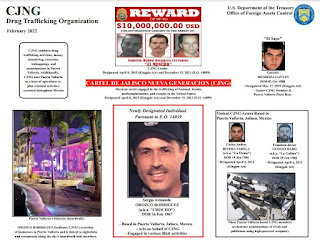
The US Includes “Chocho”, Operator Of The CJNG In Puerto Vallarta, On Its “Black” List

 "Ivan" for Borderland Beat 

Sergio Armando Orozco Rodríguez, alias “Chocho”, was included, this Thursday, February 17, in the “black list” of the Office of Foreign Assets Control (OFAC), of the United States Department of the Treasury. Joined.

With the last update in the "list of the file of specially designated persons" -in accordance with the Designation Act of Foreign Kingpins (Kingpin Act)- of the OFAC, the properties, interests and transactions of both subjects, which are in the United States or in the possession or control of US persons or in transit, will no longer be designated or blocked by the US Government.

“OROZCO RODRÍGUEZ, Sergio Armando (alias “CHOCHO”), Puerto Vallarta, Jalisco, Mexico; date of birth February 16, 1967; P.O.B. Guadalajara, Jalisco, Mexico; nationality Mexico; Male gender; CURP OORS670216HJCRDR04 (Mexico) (individual) [ILLICIT-DRUGS-EO]”, says the file published by OFAC.

According to the US Treasury Department, in collaboration with the Drug Enforcement Administration (DEA), Customs and Border Protection (CBP), and the Government of Mexico, Orozco Rodríguez was designated "in accordance with Executive Order (EO) 14059, for acting "for or on behalf" of the Jalisco New Generation Cartel (CJNG), "by facilitating various illicit activities in Puerto Vallarta, Jalisco .“CJNG, a violent organization based in Mexico, trafficks a significant proportion of the fentanyl and other deadly drugs that enter the United States […] Individuals like Sergio Armando Orozco Rodríguez help the CJNG infiltrate the economy of Puerto Vallarta and intimidate legitimate business,” Treasury Under Secretary for Terrorism and Financial Intelligence Brian E. Nelson said in a statement.

“The Cartel uses this renowned tourist destination as a strategic stronghold not only for drug trafficking, but also for money laundering, extortion, kidnapping and murder. Treasury will continue to work with US partners and the Mexican government to expose and disrupt the CJNG, from its leadership to its enablers," Nelson added.

“Sergio Armando Orozco Rodríguez, of Mexican nationality, was designated because he is directed by, or has acted or pretended to act for or on behalf, directly or indirectly, of the CJNG. He resides in Puerto Vallarta, where he is engaged in various illegal activities on behalf of the CJNG, ”said the US government.

“Orozco Rodríguez launders drug proceeds on behalf of the CJNG and has ties to some of its most important members. In addition, Orozco Rodríguez facilitates the extortion schemes of the CJNG in the Puerto Vallarta area”, detailed the US Department of the Treasury.

“For example, many new businesses there must receive an unofficial permit to open from Orozco Rodríguez. Once open, Orozco Rodríguez collects taxes from these businesses on behalf of the CJNG. Orozco Rodríguez has had ties to multiple nightclubs, bars, and restaurants in Puerto Vallarta,” the US authorities added.

OFAC recalled that it has taken previous actions against CJNG operatives based in Puerto Vallarta, which said Cartel "uses as a base of operations to plan criminal activities carried out throughout Mexico."

On April 6, 2021, OFAC designated Carlos Andrés Rivera Varela, alias “La Firma”, and Francisco Javier Gudiño Haro, “La Gallina”, who lead a CJNG enforcement group based in Puerto Vallarta, “which has helped orchestrate assassinations of rivals and politicians using high-powered weapons.”

“These two violent individuals are also linked” to Gonzalo Mendoza Gaytán, alias “El Sapo”, a “senior member of the CJNG who has served as plaza boss in Puerto Vallarta.” In addition, OFAC recalled that on April 8, 2015, it designated the CJNG, along with its leader, Rubén Oseguera Cervantes, alias "El Mencho", in accordance with the Kingpin Act, "for playing an important role in international drug trafficking." .

On December 15, 2021, OFAC also designated the CJNG and Oseguera Cervantes pursuant to EO 14059. The US Department of State Narcotics Rewards Program issued a reward of up to $10 million for information that lead to the arrest and/or conviction of “El Mencho”.

OFAC also recalled that it has designated a wide range of companies and individuals linked to the CJNG and its close ally, the Los Cuinis drug trafficking organization, whose businesses "previously designated in Mexico include shopping malls, real estate companies, farms, a music promotion business and a luxury boutique hotel.

"Many of these entities have been involved in laundering drug proceeds and represent attempts by the CJNG and Los Cuinis to integrate their illicit profits into the legitimate economy," the US Treasury Department added.

"Among the people sanctioned are those who play critical roles in the CJNG's drug trafficking activities, including money laundering, and those who facilitate corrupt activities on behalf of the CJNG and Los Cuinis," the US government concluded.

ZETA TIJUANA

Thursday, August 10, 2017

CJNG is going for control of all national territory after breaking alliance with El Mayo Zambada

Translated by Otis B Fly-Wheel for Borderland Beat from a Noreste article

Subject Matter: Territorial expansion of the CJNG
Recommendation: No prior subject matter knowledge required

(Otis: this article makes some fairly big claims about CJNG, and should promote some good discussion in the comments section.)

The Cartel Jalisco Nueva Generacion will dispute more territory with the Sinaloa Cartel after breaking its alliance with El Mayo Zambada, and taking control of Fuerzas Especiales de Los Damaso.


The Cartel Jalisco Nueva Generacion is vying for control of the entire national territory. Unofficial sources from the Centre for Research and National Security (CISEN) presume that the break up of the organization led by Nemesio Oseguera Gonzalez, El Mencho, with the faction of the Sinaloa Cartel headed by Ismael Zambada Garcia, El Mayo, with whom he had an alliance after the recapture of Joaquin Guzman Loera, El Chapo, in January of 2016.

The breakup of the two cartels, the two most important in drug trafficking in Mexico, could have been motivated by the recent delivery to the US authorities of Damaso Lopez Serrano, El Mini Lic, head of the Los Damaso faction of the Sinaloa Cartel, after the capture of his father, and head of the Fuerzas Especiales del Damaso. FED had allegedly been transferred to the control of the CJNG.


Sunday, October 20, 2019

Cartel War in Guanajuato

Chivis Martinez Borderland Beat POPlab

click on image to enlarge


Anatomy of war

All armed conflict maps are photographs of the moment. The displacement of troops, conquests of territories, retreats and offensives are subject to fluctuations due to the disposition of resources, reactions of the adversary, errors, successes and blows of luck, common in any armed conflagration. The radiography presented below is necessarily provisional. It is a first approach, by bird flight, of the current position occupied by the armies participating in the war for Guanajuato on the battlefield. Some tendencies can be established in the course of the cartel war. But they are that, tendencies that tomorrow can be reversed, accentuated or diluted.

Let's move on to a first conclusion

Because of the number of municipalities they control and the territories that occupy the main cartels (Jalisco Cartel New Generation -CJNG- and Santa Rosa de Lima Cartel -CSRL-) it is clear that it will take a long time before we can expect the end of hostilities . The cartels have accumulated too many troops, resources and consolidated many territories that are under their control. They have regular funding sources, recruitment schemes and alliances that allow them to remain active.

Thursday, November 30, 2023

Treasury Takes Third Action Against CJNG Timeshare Fraud Network Centered in Puerto Vallarta: Jalisco

 "Char" for Borderland Beat 

This press release was republished from the U.S. DEPARTMENT OF TREASURY 


Treasury Coordinates with Government of Mexico to Further Disrupt CJNG Timeshare Fraud

WASHINGTON — Today, the U.S. Department of the Treasury’s Office of Foreign Assets Control (OFAC) sanctioned three Mexican individuals and 13 Mexican companies.  These individuals and companies are linked, directly or indirectly, to timeshare fraud led by the Cartel de Jalisco Nueva Generacion (CJNG). CJNG, a violent Mexico-based organization, traffics a significant proportion of the illicit fentanyl and other deadly drugs that enter the United States. OFAC coordinated this action with the Government of Mexico, including its Financial Intelligence Unit, as well as U.S. Government partners, including the Federal Bureau of Investigation (FBI), and the Drug Enforcement Administration.   

“The CJNG cartel, a leading trafficker of narcotics like illicit fentanyl into the United States, generates substantial revenue for its multi-faceted criminal enterprise through its timeshare fraud network,” said Secretary of the Treasury Janet L. Yellen. “CJNG uses extreme violence and intimidation to control the timeshare network, which often targets elder U.S. citizens and can defraud victims of their life savings. Treasury remains committed to the Administration’s whole-of-government effort, in coordination with our partners in Mexico, to disrupt CJNG’s revenue sources and ability to traffic deadly drugs like fentanyl.”   

EXPOSING CJNG TIMESHARE FRAUD

On March 2, 2023, OFAC sanctioned eight Mexican companies pursuant to Executive Order (E.O.) 14059.  These companies are linked, directly or indirectly, to CJNG’s timeshare fraud activities. On April 27, 2023, OFAC sanctioned seven Mexican individuals, including drug trafficking fugitive Eduardo Pardo Espino, and 19 Mexican companies pursuant to E.O. 14059. These individuals and companies are also linked, directly or indirectly, to CJNG’s timeshare fraud activities.

Although there are different types of timeshare fraud, the schemes often involve the following: (1) third-party scammers, who claim to have ready buyers, make unsolicited purchase offers to timeshare owners;

(2) if offers are accepted, scammers make requests to timeshare owners for payments of advance fees and taxes, supposedly to facilitate or expedite the sale with assurances of reimbursement upon closing; and

(3) once multiple payments have been made to the scammers, timeshare owners eventually realize that the offers were fictitious, that there are no buyers, and that their money is gone. 


CONTINUING TO DISRUPT CJNG’S TIMESHARE FRAUD NETWORK


Building on the two actions taken earlier this year, today OFAC sanctioned additional Mexican individuals and companies pursuant to E.O. 14059 that are linked, directly or indirectly, to CJNG’s timeshare activities. Many of these individuals and entities are located in Puerto Vallarta, Jalisco, Mexico, which is a CJNG strategic stronghold for drug trafficking and various other illicit activities.   

Today, OFAC sanctioned Mexican individuals Teresa De Jesus Alvarado Rubio(Alvarado), Manuel Alejandro Foubert Cadena (Foubert), and Gabriela Del Villar Contreras (Del Villar) pursuant to E.O. 14059 for being owned, controlled, or directed by, or having acted or purported to act for on behalf of, directly or indirectly, CJNG, a person sanctioned pursuant to E.O. 14059. Alvarado has been linked to timeshare fraud activities in the Puerto Vallarta area for approximately 15 years. Foubert has been linked to timeshare fraud activities in Puerto Vallarta and elsewhere since at least 2016. Del Villar is a Puerto Vallarta attorney who engages in debt collection and real estate fraud on behalf of CJNG. 

Also today, OFAC sanctioned 13 Mexican companies pursuant to E.O. 14059. OFAC sanctioned Grupo Empresarial Epta, S.A. de C.V., which is purported to be engaged in real estate activities, for being owned, controlled, or directed by, or having acted or purported to act for or on behalf of, directly or indirectly, CJNG. 

OFAC sanctioned the following nine companies—listed with their purported activities—for being owned, controlled, or directed by, or having acted or purported to act for or on behalf of, directly or indirectly, Foubert, a person sanctioned pursuant to E.O. 14059: Assis Realty And Vacation Club, S.A. de C.V. (real estate activities), Axis Sale & Maintenance Buildings, S.A. de C.V. (real estate activities), Comercializadora de Servicios Turisticos de Vallarta, S.A. de C.V. (real estate activities), Condos & Vacations Buildings Sale & Maintenance, S.A. de C.V. (real estate activities), Grupo Minera Barro Pacifico, S.A.P.I. de C.V. (mining), International Realty & Maintenance, S.A. de C.V. (real estate activities), Mega Comercial Ferrelectrica, S.A. de C.V. (wholesale trade), Real Estates & Holiday Cities, S.A. de C.V. (real estate activities), and Terra Minas e Inversiones del Pacifico, S.A.P.I. de C.V. (mining). 

OFAC sanctioned the following three Mexican companies—listed with their purported activities—for being owned, controlled, or directed by, or having acted or purported to act for or on behalf of, directly or indirectly, Del Villar, a person sanctioned pursuant to E.O. 14059: Banlu Comercializadora, S.A. de C.V. (a.k.a. Cear Gym) (wholesale trade; sports club), Crowlands, S.A. de C.V. (real estate activities), and Skairu, S.A. de C.V. (real estate activities).   

OTHER ACTIONS AGAINST CJNG

On April 8, 2015, OFAC sanctioned CJNG pursuant to the Foreign Narcotics Kingpin Designation Act (Kingpin Act) for playing a significant role in international narcotics trafficking. On December 15, 2021, OFAC also designated CJNG pursuant to E.O. 14059. In other actions, OFAC has sanctioned numerous CJNG-linked companies that were engaged in various commercial activities and multiple individuals who played critical roles in CJNG’s drug trafficking, money laundering, and corruption. Many recent actions have focused on CJNG’s strategic stronghold of Puerto Vallarta. OFAC has sanctioned the following senior CJNG members based in Puerto Vallarta: Carlos Andres Rivera Varela (a.k.a. “La Firma”), Francisco Javier Gudino Haro (a.k.a. “La Gallina”), and Julio Cesar Montero Pinzon (a.k.a. Luis Armando Velazquez Baltazar; a.k.a. Cesar Hernandez Jimenez; a.k.a. “El Tarjetas”). These three individuals are part of a CJNG enforcement group based in Puerto Vallarta that orchestrates assassinations of rivals and politicians using high-powered weaponry. 

TIMESHARE FRAUD RESOURCES

On March 2, 2023, the FBI issued a public service announcement to consumers concerning scammers targeting owners of timeshares in Mexico.  Victims of this type of scam are encouraged to file a complaint with the FBI’s Internet Crime Complaint Center by visiting https://www.ic3.gov.   

At times, perpetrators of timeshare fraud misuse government agency names in attempts to appear legitimate. For example, perpetrators may call victims and claim to represent OFAC, demanding a payment in exchange for the release of funds that the perpetrator claims OFAC has “blocked.” On March 2, 2023, OFAC issued an alertregarding such scams, warning that individuals may falsely claim to represent OFAC in furtherance of their fraud.

SANCTIONS IMPLICATIONS


As a result of today’s action, all property and interests in property of the designated persons described above that are in the United States or in the possession or control of U.S. persons are blocked and must be reported to OFAC. In addition, any entities that are owned, directly or indirectly, individually or in the aggregate, 50 percent or more by one or more blocked persons are also blocked. Unless authorized by a general or specific license issued by OFAC, or exempt, OFAC’s regulations generally prohibit all transactions by U.S. persons or within (or transiting) the United States that involve any property or interests in property of designated or otherwise blocked persons. U.S. persons may face civil or criminal penalties for violations of E.O. 14059 and the Kingpin Act.

Today’s action is part of a whole-of-government effort to counter the global threat posed by the trafficking of illicit drugs into the United States that is causing the deaths of tens of thousands of Americans annually, as well as countless more non-fatal overdoses. OFAC, in coordination with its U.S. Government partners and foreign counterparts, will continue to target and pursue accountability for foreign illicit drug actors.

The power and integrity of OFAC sanctions derive not only from OFAC’s ability to designate and add persons to the Specially Designated Nationals and Blocked Persons List (SDN List), but also from its willingness to remove persons from the SDN List consistent with the law. The ultimate goal of sanctions is not to punish, but to bring about a positive change in behavior. For information concerning the process for seeking removal from an OFAC list, including the SDN List, please refer to OFAC’s Frequently Asked Question 897 here. For detailed information on the process to submit a request for removal from an OFAC sanctions list, please click here.

For more information on the individuals and entities designated today, click here.

To view a chart on the entities designated today, click here.

###