![]() |
| Rafael Caro Quintero is out of legal options to prevent his US extradition process from being approved by the Mexican government (photo credit: Infobae) |
Wednesday, August 30, 2023
Nearing US Extradition: Appeals Court Rejects Rafael Caro Quintero's Final Motions
Sunday, March 2, 2025
Rafael Caro-Quintero Pleads Not Guilty in New York Court to Killing DEA Agent 'Kiki' Camarena
"Socalj" for Borderland Beat
At Rafael Caro-Quintero's arraignment in New York federal court, Assistant US Attorney Saritha Komatireddy said Caro-Quintero "pioneered Mexican drug trafficking" and the violent enforcement of his cartel's turf.
Judge Robert M. Levy clarified in court Caro Quintero was expelled from Mexico under a provision within the national security law, which permits the Mexican government to remove an individual without undergoing the formal extradition process.
Friday, August 9, 2013
Convicted of DEA Agent's Murder Caro Quintero Ordered Released
Therefore, prison authorities at the state prison in El Salto, Jalisco, determined that he would be released, he left the prison at dawn, hours before the court ruling was made public.
Caro Quintero was born in La Noria, Badiraguato, Sinaloa. Quintero was a co-founder, with Miguel Ángel Félix Gallardo,, of the Guadalajara Cartel and Sonora Cartel. Upon the cartels' disintegration, its leaders were incorporated mostly into the Tijuana cartel and Sinaloa Cartel.
Camarena (at left) was kidnapped, in Guadalajara, the capital city of Jalisco and a major drug trafficking hub. His body and that of his Mexican pilot, both reflecting signs of extreme torture, were found a month later, buried in shallow graves.
Camarena was subjected to some of the worse known methods of torture in drug war history. A physician was forced to revive Camarena when he was on the brink of death to subject the agent to further torture.
In June of this year the US Government placed sanctions on those involved in the Camarena murder, including Caro Quintero.
Caro Quintero faces charges in the United States, but Mexico's Attorney General's Office said it was unclear whether there was a current extradition request.
Apparently, the U.S. had requested his extradition for the Camarena killing — something Caro Quintero can't be tried twice for — but may not have filed extradition requests for pending U.S. drug charges.
Video is from the Camarena Legacy Foundation-In the video his family speak about Kiki's life and the murder, his oldest son was only 11 years old at the time of his father's death.
Tuesday, July 19, 2022
Rafael Caro Quintero Extradition Delay, There Will Be An Amparo Trial
"HEARST" for Borderland Beat
Yesterday, judges ruled on two of Rafael Caro Quintero’s amparo filings. In one, a judge ruled that he cannot be deported from Mexico to the US until his other amparo claims against extradition have been reviewed and ruled on.
Two Amparos Down, More Still To Go
On July 16, 2022, Rafael Caro Quintero was officially notified of the provisional arrest warrant for extradition purposes inside Altiplano prison. This notification is the first step outlined in the US-Mexico extradition treaty.
Monday, July 24, 2023
DEA Planning for Early 2024 Extradition of Rafael Caro Quintero
"Morogris" for Borderland Beat
![]() |
| Former Guadalajara Cartel leader Rafael Caro-Quintero (left) and US Drug Enforcement Administration (DEA) agent Enrique "Kiki" Camarena Salazar (right) |
The United States Drug Enforcement Administration (DEA) expects the extradition of Rafael Caro Quintero from Mexico to occur in early 2024. Caro Quintero is wanted in the US for the 1985 murder of DEA agent Enrique "Kiki" Camarena.
DEA official George Papadopoulo told Grupo Reforma that the US government does not expect for the extradition to delay past 2024.
Thursday, October 10, 2019
RCQ, "El Rafa", Denied Amparo against US Extradition
The Supreme Court of Justice of the Nation (SCJN) of Mexico refused to protect drug trafficker Rafael Caro Quintero against extradition to the United States which is ordered against him, so if he was arrested he could be sent to the US where he has outstanding warrant for his prosecution.
Friday, July 15, 2022
Rafael Caro Quintero Arrested. Day 1
Borderland Beat Contributors
Rafael Caro Quintero, the leader of the Caborca Cartel and a top target of the United States government has been captured by the Mexican Navy in San Simón, Sinaloa. There were initially multiple conflicting reports as to the location of his arrest, first having the operation taking place in Guachochi, Chihuahua.
Wednesday, May 5, 2021
Mexican Court Approves US Extradition of Rafael Caro Quintero
"Morogris" for Borderland Beat
![]() |
| Former Guadalajara Cartel leader Rafael Caro Quintero (left) and US Drug Enforcement Administration (DEA) agent Enrique "Kiki" Camarena Salazar (right) |
The long battle to extradite drug kingpin Rafael Caro Quintero is finally over, should he be arrested.
A Mexican tribunal court approved Caro Quintero for extradition after denying a motion he had issued to prevent Mexican authorities from sending him to the US. Caro Quintero's defense team argued that being extradited to the US meant he would face double jeopardy.
In Mexico, Caro Quintero was sentenced to 40 years in prison for the 1985 murder of US Drug Enforcement Administration (DEA) agent Enrique Camarena Salazar and the Mexican pilot Alfredo Zavala Avelar. In the US, Caro Quintero is also wanted for Camarena's murder, and the US government has publicly express over the years that he will be tried for his death should he be extradited. Caro Quintero argued that this was double jeopardy.
According to Article 15 of the Extradition Treaty between Mexico and the U.S., the Mexican government will not extradite a Mexican national unless multiple conditions are met. Among them include that the Mexican national does not face double jeopardy (i.e. being charged for Camarena's murder in Mexico and then in the US).
However, the tribunal court responded by denying Caro Quintero's motion and explained that although the US extradition request does contain the Camarena murder charge, it also includes other charges like drug trafficking and money laundering, which in itself makes the extradition request legitimate.
In addition, it is worth nothing that the murder charge Caro Quintero would face in the US is different than the one he was convicted for in Mexico. In Mexico, he was convicted of murder at the state-level with no aggravating factors.
But in the US, Caro Quintero is facing a federal violation of 18 U.S. Code § 115. This code covers a specific type of murder: whoever kills or attempts to kill any officer or employee of the United States. This aggravating factor in the murder charge was enough for the court to rule it is not double jeopardy.
Caro Quintero, the former leader of the Guadalajara Cartel, was freed from a Mexican state jail on a legal technicality in 2013, but an arrest warrant was issued by federal authorities a few months after his release. He is currently a fugitive and is believed to be in hiding in Mexico.
Sources: El Sol de Mexico; El Economista; El Financiero; LII; Borderland Beat analysis
Friday, March 26, 2021
Court Rejects Motion Issued by Rafael Caro Quintero; Judge He Wanted Out Will Preside in Extradition Hearing
"MX" for Borderland Beat
A Mexican federal court rejected a motion issued by Rafael Caro Quintero, who intended to prevent judge Francisco Javier Sarabia Ascencio from presiding in his extradition hearings.
Sarabia Ascencio has presided over Caro Quintero's extradition case over the years and once granted him a petition that slowed his US extradition request. A Mexican media outlet stated that Sarabia Ascensio reportedly received payments from Caro Quintero in exchange for favorable court rulings.
But a few months ago Caro Quintero told the court that he no longer wanted Sarabia Ascencio in his hearings, which suggested a possible fall out with the judge in question.
This is not the first time that Caro Quintero has issued motions to prevent certain judges from presiding in his cases. In 2015, he issued a motion to prevent judges Arturo Zaldivar Lelo de Larrea and Luis Maria Aguilar Morales from having a decision on whether Caro Quintero's extradition was allowed under the US and Mexico Extradition Treaty.
Caro Quintero, the former leader of the Guadalajara Cartel, is wanted for the 1985 murder of US Drug Enforcement Administration (DEA) agent Enrique Camarena Salazar.
In 2013, he was freed from a Mexican state jail on a legal technicality, but an arrest warrant was issued by federal authorities a few months after his release. He is currently a fugitive and is believed to be in hiding in Mexico.
If Caro Quintero is ever arrested in Mexico, officials say he will likely be extradited to the US. In the US, he is wanted for kidnapping and murder of a US federal officer, as well as drug trafficking, money laundering and for leading a continuous criminal enterprise.
The US government is offering a US$20 million bounty for his capture. This is the highest reward the U.S. offers for a Mexican criminal.
Sources: Milenio; Debate de Sinaloa; El Economista; NRT Mexico; Borderland Beat archives
Saturday, July 16, 2022
Rafael Caro Quintero Arrested. Day 2
Rafael Caro Quintero was arrested yesterday, July 15, 2022, by Mexican federal forces.
This was a live post that was periodically updated by Borderland Beat contributors with the latest information that came out on Rafael Caro Quintero.
Quick Review
Who
Rafael Caro Quintero, the Mexican cartel leader who had the highest bounty offered by the US government, with a $20 million reward offered. The large reward being offered by the US for his capture is, in part, due to his alleged involvement in the abduction, torture, and murder of US DEA agent Kiki Camarena in 1985.
He is the leader of the Caborca Cartel, which mainly operates in the state of Sonora. He was one of the founders of the Guadalajara Cartel. For all the extra background information you need to know on who he is, please see this post.
What
Mexican Navy Marines arrested Rafael Caro Quintero who was hiding out in a remote mountainous area. A military canine, a bloodhound named Max, was specifically credited with finding him, after tracking him down based on his scent.
Thursday, May 12, 2016
U.S. Says Wife of Rafael Caro Quintero is Conducting Cartel Activites on his behalf
Saturday, August 13, 2016
Rafael Caro Quintero girlfriend speaks out
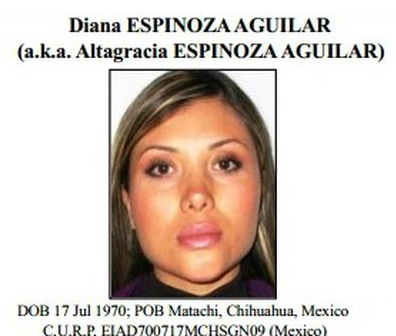
Diana Espinoza Aguilar, 45, is originally from Matachi, Chihuahua, she has a figure that, wherever she goes, she attracts people attention. But since May she attracted the attention of someone who keeps her awake: the United States Department of the Treasury announced her name and her picture, and accused her of being a drug trafficker and facilitating illegally economic resources to her boyfriend, Rafael Caro Quintero , one of the most wanted by the DEA.
In an interview with Proceso, Espinoza, the girlfriend of Caro Quintero for six years now speaks for the first time of her relationship with him. She also explains the legal strategy that they are working on to stop being a fugitive and responds to accusations of money laundering.
"I am innocent, I have absolutely nothing to do with what they are telling the media: that I'm a drug dealer, a money launderer for Rafael Caro Quintero ... I'm his wife, I am the mother of his child," she says.
Friday, May 29, 2020
Rafael Caro Quintero Wants to Delay Extradition Hearing; Claims He Is Poor and That Judge Is Plotting Against Him
![]() |
| Rafael Caro Quintero |
Sunday, July 16, 2023
Caro Quintero Fights In Court To Avoid Being Brought To Justice In The U.S.
"Sol Prendido" for Borderland Beat
Attempts by Rafael Caro Quintero, one of Mexico's biggest drug traffickers on record, to avoid being sent to the United States have been constant. He has even sought to take his legal situation to the Supreme Court of Justice of the Nation (SCJN) to stop a possible extradition.
Judicial records indicate that the founder of the Guadalajara Cartel and accused of the alleged kidnapping and murder of a federal DEA agent Enrique "Kiki" Camarena, in 1985, has filed a total of 19 amparo lawsuits before the federal justice system.
Most of them have been to avoid being sent and tried for various crimes in the U.S., but others seek to revoke the arrest warrant issued against him for organized crime and drug trafficking and some others to guarantee him better health services in the maximum security prison of Altiplano, in Almoloya de Juarez, State of Mexico.
Just last June 3, a federal court denied him an injunction against an alleged arrest warrant for extradition to the United States.
The magistrates of the Second Collegiate Court in Criminal Matters of the State of Mexico unanimously confirmed the decision of Judge Tania Rosalinda Méndez, in Federal Amparo Proceedings in the State of Mexico, who refused to grant the drug trafficker amparo protection.
A month earlier, the Supreme Court refused to review an injunction filed by Caro Quintero's lawyers against his extradition to the United States.
Of the 19 amparos filed by the drug trafficker's lawyers, only 5 have been resolved against him, the rest are ongoing in courts and tribunals in the State of Mexico, Jalisco and Mexico City.
How was Caro Quintero's capture and recapture?
Caro Quintero was the founder of the Guadalajara cartel along with Miguel Angel Felix Gallardo and Ernesto Fonseca Carrillo, with whom he began working in the 1970s. During the 1980s, he acquired so much power that he was nicknamed: "Narco de Narcos" (Narco of Narcos).
He was arrested in San José, Costa Rica, on September 18, 1985 and later extradited to Mexico.
On December 12, 1989, Caro Quintero was sentenced for the crimes of kidnapping, aggravated homicide, planting, growing, harvesting, transporting and trafficking marijuana, supplying cocaine and criminal association. He was sentenced to 40 years in prison.
He was in the Federal Center for Social Readaptation of Altiplano, in the State of Mexico. In 2007 he was transferred to the maximum security prison of Puente Grande, where he was held until 2010, when he was transferred to the Guadalajara Preventive Prison.
Caro Quintero spent 28 years in prison and was released by a judge.
On August 9, 2013, Rafael Caro Quintero was released after serving 28 years in prison. A court in Guadalajara ordered his immediate release because it considered that the murder of the U.S. agent in February 1985 should have been tried in the common courts and not in the federal courts.
On July 15, 2022, one of the most wanted drug lords in Mexico and the United States was recaptured while hiding in the bushes of the town of San Simon, in Choix, Sinaloa.
Following his recapture, U.S. authorities indicated that they will request Caro Quintero's extradition for the DEA agent's crime, which is a federal crime in the United States.
Caro Quintero is also charged with cocaine trafficking, running a "criminal enterprise", i.e. a cartel, criminal association and violent crimes, as well as kidnapping and murder.
Thursday, July 21, 2022
Attorney Generals of US & Mexico Agree to Work Together on Caro Quintero's Extradition
![]() |
| US Attorney General Merrick B. Garland and FGR Head Alejandro Gertz Manero will work to extradite Caro Quintero to the US. |
The Attorney General of the United States and his Mexican counterpart from the Attorney General's Office (FGR) held a call to reaffirm the extradition request of Rafael Caro Quintero recaptured in the cradle of the Sinaloa Cartel last week.
Merrick B. Garland and Alejandro Gertz Manero, head of the FGR, spoke by telephone on July 21, where they discussed sending the capo accused of multiple charges, including the kidnapping and murder of Enrique Camarena Salazar, "Kiki", an agent of the Administration of the Drug Enforcement (DEA) in 1985.
"The two leaders reaffirmed their shared commitment to continue working in unison on the extradition of Caro-Quintero," the Justice Department said in a brief statement.
According to the US authorities, the talk between the two officials took place during the afternoon. This is the first official communication reported after Caro Quintero was made available to the ministerial authorities and was notified of the extradition request for crimes charged in the US.
"Attorney General Garland offered his condolences to the families and loved ones of the Mexican military who gave their lives in the service of their country last week," added the US official about the alleged accident on July 15 in a corn field in Los Mochis.
According to the Department of Justice, the call with Gertz Manero was also to continue in the line of binational collaboration for cases that are committed on both sides of Mexico and the United States, in order to find those responsible for various crimes.
"They are committed to continuing to build on a successful collaboration in criminal investigations and prosecutions of cross-border crimes," concluded the Merrick B. Garland press office.
The FGR has not issued any further comments on the communication between the officials. Nor has it reported on the judicial process that awaits the person who was a founder of the Guadalajara Cartel.
The DEA indicated that the recapture of Caro Quintero was a prolonged collaboration between the security institutions headed by the DEA. But the United States Ambassador in Mexico, Ken Salazar, as well as Mexican President AMLO tried to curb those attributions leaked to the press and reiterated that the credit belonged to Semar.
Garland's call to Gertz Manero comes after the sister of the "Narco de Narcos" obtained an injunction so that her family member would not be transferred from the prison where he is located in the maximum security prison of the Altiplano, State of Mexico. The lawsuit charges that the authorities did not follow the extradition procedure and a legal battle is expected before the capo is sent to the country that has requested him for 37 years, when he was arrested in Costa Rica, he spent 28 years in prison and managed to free the prison until last July 15.
UPDATED
U.S. Attorney General Merrick B. Garland spoke by phone with Mexico’s Secretary of Foreign Affairs Marcelo Ebrard Casaubon. The two leaders previously met in Mexico City during the first U.S.-Mexico High-Level Security Dialogue (HLSD). During today’s call, Attorney General Garland expressed his gratitude to Secretary Ebrard and the Government of Mexico for successfully arresting Rafael Caro-Quintero. The Attorney General also offered his condolences to the families and loved ones of the Mexican servicemembers who gave their lives in service to their country last week. The two leaders reaffirmed their shared commitment to working expeditiously on the extradition of Caro-Quintero, who is wanted in the United States on a number of criminal charges, including his alleged involvement in the kidnapping and murder of Drug Enforcement Administration Special Agent Enrique “Kiki” Camarena in 1985.
Saturday, July 16, 2022
Semar Black Hawk Helicopter Crashes After RCQ Operation Killing 14 Marines Near Los Mochis, Sinaloa
"Socalj" for Borderland Beat
| Shortly after the operation capturing wanted fugitive Caro Quintero, a Black Hawk helicopter crashed killing 14 Mexican Marines with 1 surviving in critical condition. |
![]() |
| The locations of Rafael Caro Quintero's capture and the Semar helicopter crash shortly after. The Black Hawk UH-60M was likely returning to base while near the Los Mochis airport. |
![]() |
| Max, a trained Bloodhound tracked RCQ finding him hidden in the bushes of the mountains of San Simon. |
![]() |
| Federal troops, including agents from the Attorney General's Office, located RCQ who has two arrest warrants and a request for extradition to the United States. |
Units of the Municipal Police arrived at the site together with elements of the Mexican Red Cross and under the supervision of another Semar aircraft, who confirmed the fatal victims of the accident, which occurred in the Topolobampo Industrial Zone, near the Los Mochis highway, Topolobampo towards the port.
![]() |
| Caro Quintero was transported by plane after his capture in Sinaloa. |
![]() |
Some photographs showed the journey of Caro Quintero, heavily escorted by federal agents. |
Statement Excerpts from the US and Mexico
AMLO pointed out that the members of the Navy who died in the crash of a helicopter belonging to the unit near Los Mochis, in Sinaloa, supported the capture of Rafael Caro Quintero, founder of the Guadalajara cartel.
“I send my most sincere condolences and hugs to his family, colleagues and friends. The Secretary of the Navy, José Rafael Ojeda Durán, has informed me that an investigation will be ordered to find out the causes of the crash of the helicopter in which they were traveling when they were about to land in Los Mochis, Sinaloa, after fulfilling the mission of supporting those who they executed the arrest warrant against Rafael Caro Quintero,” AMLO highlighted on his social networks.
In social networks, the President of the Senate, Olga Sánchez Cordero wrote: “I join in the condolences to the Mexican Navy and the relatives of the deceased sailors, always in the delivery and at the service of our country, after the crash of the helicopter in which they were traveling. I also join the request that these facts be investigated.”
DEA Administrator Anne Milgram
Today, our incredible DEA team in Mexico worked in partnership with Mexican authorities to capture and arrest Rafael Caro Quintero, who is charged in the United States with the torture and murder of DEA Special Agent Kiki Camarena and with many other crimes. For more than 30 years, the men and women of DEA have worked tirelessly to bring Caro Quintero to justice. Today’s arrest is the result of years of your blood, sweat, and tears.
Saturday, August 10, 2013
US Furious over Rafael Caro Quintero's release
MEXICO CITY -- U.S. law enforcement officials expressed outrage over the release from prison of Mexican drug lord Rafael Caro Quintero and vowed to continue efforts to bring to justice the man who ordered the killing of a U.S. Drug Enforcement Administration agent.
The 60-year-old walked out of a prison in the western state of Jalisco early Friday after serving 28 years of his sentence.
The U.S. Department of Justice said it found the court's decision "deeply troubling."
"The Department of Justice, and especially the Drug Enforcement Administration, is extremely disappointed with this result," it said in a statement.
The Association of Former Federal Narcotics Agents in the United States said it was "outraged" by Caro Quintero's early release and it blamed corruption within Mexico's justice system for his early release.
"The release of this violent butcher is but another example of how good faith efforts by the U.S. to work with the Mexican government can be frustrated by those powerful dark forces that work in the shadows of the Mexican `justice' system," the organization said in a statement.
The DEA, meanwhile, said it "will vigorously continue its efforts to ensure Caro-Quintero faces charges in the United States for the crimes he committed."
Caro Quintero was a founding member of one of Mexico's earliest and biggest drug cartels. He helped establish a powerful cartel based in the northwestern Mexican state of Sinaloa that later split into some of Mexico's largest cartels, including the Sinaloa and Juarez cartels.
But he wasn't tried for drug trafficking, a federal crime in Mexico. Instead, Mexican federal prosecutors, under intense pressure from the United States, hastily put together a case against him for Camarena's kidnapping and killing, both state crimes.
"What we are seeing here is a contradiction between the need of the government to keep dangerous criminals behind bars and its respect of due process," said Raul Benitez, a security expert at Mexico's National Autonomous University.
"The United States wants Mexico to comply with due process but it is likely that due process was not followed when many criminals were caught 10 or 15 years."
Tuesday, February 7, 2023
Carlos Caro Quintero, Brother of RCQ, Arrested in Mexico City
"HEARST" for Borderland Beat
Carlos Caro Quintero, the brother of Rafael Caro Quintero, was arrested in Mexico City on charges of illegal firearm and drug possession.
The Arrest
At 4:00 pm on February 6, 2023, Mexico City’s Head of Security, Omar Garcia Harfuch, announced on Twitter that:
Wednesday, October 9, 2019
Rumors Growing: RCQ, Rafael Caro Quintero Recent Photo Surfaces, Seen in Sinaloa ?

Tuesday, April 16, 2024
Another Narco Weakling Denies Who He Is
"Sol Prendido" for Borderland Beat
The old school boss Rafael Caro Quintero assures that he is not Rafael Caro Quintero. This is one of the arguments that he presented before a federal court to avoid his extradition to the United States, arguing that he is not the drug lord that the US Department of Justice is looking for. According to judicial documents to which Reforma had access, Caro Quintero requested that 10 expert opinions be carried out.
Among them those of the physical identity system and forensic photography to try to demonstrate that his capture was a mistake and that in any case the real drug trafficker is still out there. As in the formal extradition request, the Americans offered a video in which the drug trafficker appears. He also requested that computer experts be applied in analysis of audio, video, photographs, and stenographic transcriptions.
As well as acoustics, phonetics, forensics, and voice analysis. The informative note clarifies that although Caro Quintero hasn’t denied his name in the process. He has a legal strategy position with which he wants to convince that scientifically his features don’t coincide with those of the 7 photographs or a video submitted in the extradition file. In this type of procedures, the photos and images in general presented by the requesting country are the only ones that can be taken into account to establish the identity of the extraditable person.
This argument is the same one raised by Ovidio Guzmán López, son of Chapo Guzmán, as well as other drug traffickers. Like Eduardo Arellano Félix aka El Doctor and Marco Antonio Paredes Machado, Chapo's operator in Sonora among others. Extradition trials can only be litigated with two arguments or exceptions: proving that the detainee is not the person sought by the requesting country and proving that the formal process doesn’t comply with the extradition treaty between the two countries.
Caro Quintero has implemented a legal strategy with the purpose of significantly prolonging his extradition to the United States. An action that they consider that he has at his disposal. This perception is based on the absence so far of a legal ruling by Judge Marcela Castro Núñez in charge of the extradition process. Furthermore, it is expected that even after this determination the Secretary of Foreign Affairs should make a ruling, probably followed by the presentation of an amparo by the boss.
Which will require resolution in two additional instances. This complete procedural course is estimated to take more than one year to complete. On the one hand, Caro Quintero argues that the extradition request violates the legal principle of Non bis in ídem, which establishes that no one can be tried twice for the same crime. The reasoning is that since he was already tried in Mexico and sentenced to 40 years in prison for the murder of Camarena in 1985, he cannot be tried again for the same crime in the United States.
It is important to note that when the United States presented the formal extradition request, it didn’t only request his surrender for the Camarena case. It was also for three other accusations that the United States had not previously processed for his provisional detention. The Americans also formally requested his extradition to stand trial on four criminal charges. So, if the extradition in the Camarena case fails, the Americans have other actions pending in different courts.


.webp)