Blog dedicated to reporting on Mexican drug cartels
on the border line between the US and Mexico
.

Showing posts sorted by relevance for query FENTANYL. Sort by date Show all posts

Wednesday, April 17, 2024

China Continues to Subsidize Fentanyl Precursor Chemicals According to US Congress

"Socalj" for Borderland Beat


"The PRC (People's Republic of China) scheduled all fentanyl analogs as controlled substances in 2019, meaning that it currently subsidizes the export of drugs that are illegal under both U.S. and PRC law," the report said, adding that some of the substances "have no known legal use worldwide."

The report cited data from the Chinese government's State Taxation Administration website, which listed certain chemicals for rebates up to 13%. It additionally currently subsidizes 2 fentanyl precursors used by drug cartels - NPP and ANPP, it said.

Monday, May 22, 2023

The Chapitos Fentanyl Precursor Network. Brokers, Cryptocurrencies and Chinese Chemical Corporations

"Redlogarythm" for Borderland Beat

Special thanks to Huaso and Hearst for the editing, collaboration and advice

Disclaimer: the following report reflects only the author´s personal opinion regarding a subject, the trafficking of fentanyl, which has been and still is subjected to a frantic political debate. Thus, any opinion or statement being done in the following text can only be attributed to its author.


On April 14th, the United States Office of Foreign Assets Control (OFAC) sanctioned five individuals and two companies accusing them of complicity in the supplying of precursor chemicals for the Sinaloa cartel´s "Chapitos" faction. According to American authorities, these individuals and corporate vehicles were integral part of the "Chapito"´s faction fentanyl precursors supply network.

Four of the individuals were Chinese: Hongfei Wang (王洪飞), Yaqin Wu (吴雅琴), Yonghao Wu (吴永昊) and Huatao Yao (姚华涛) and one was Guatemalan: Ana Gabriela Rubio Zea. Both companies were also Chinese: Suzhou Xiaoli Pharmatech Co. Ltd. and Wuhan Shuokang Biological Technology Co. Ltd.


According to a press release made public on the same day, the individuals and companies were sanctioned for their role in the supply of precursor chemicals -specifically N-BOC-4-Piperidone- used for fentanyl manufacturing. In some cases the precursors were shipped from the People´s Republic of Chine (PRC) and shipped firstly to Guadalajara, Jalisco, from where they were re-shipped to the State of Sinaloa. The deals between both parties -Chinese producers and Mexican clients- were facilitated through a Guatemalan intermediator -Ana Gabriela Rubio Zea- who was in charge of introducing the precursors into Mexico hiding them in containers and disguising their illicit nature as if they were part of food and legal chemical shipments.


Interestingly enough, the OFAC also sanctioned a Bitcoin address owned by Wang Hongfei -3PKiHs4GY4rFg8dpppNVPXGPqMX6K2cBML- which was used for receiving payments on the behalf of Mexican clients. This has turned out to be a considerably important event since it is the first time that a specific Bitcoin address is publicly associated to the activity of Mexican organized crime.


Nevertheless, in order to fully understand the complexity and importance of this network we must take a step back and analyze it from a wider perspective, since the OFAC actions are part of a much broader effort by American authorities in their recent offensive against los Chapitos faction which detonated on April 4th when a three different US courts unsealed five indictment one of which included twenty three arrest warrants including Yonghao Wu, Yaqin Wu, Huatao Yao and Ana Gabriela Rubio Zea.


In the current report Borderland Beat tries to dig into how this network -and by extension Mexican organized crime chemical precursor supply networks are managed-. For doing so we have focused not only in the mere logistical aspect of the trade but also in the role played by brokers and intermediaries between parties and the use of cryptocurrency to make quick and easy payments beyond borders. We hope our efforts will add a bit of light into an area -the procurement of chemical precursors- about which too much has been written but very few truths told.

Monday, May 15, 2023

Fentanyl & El Mayo - Damaso's Rebuttal to los Chapitos

"HEARST" and "Ivan" for Borderland Beat


A review of the verifiable evidence which corroborates the claims in the response letter from Damaso López Serrano, alias “El Mini Lic”.  


His letter acts as rebuttal to a letter that los Chapitos released earlier this month. The Chapitos were, in turn, were responding to specific parts of the US indictment, or stating their personal grievances. 


It can be difficult to keep track of the various claims and responses. This article aims to match up each claim and subsequent response, to create a more comprehensive view of these letters. To read any of these documents in full, please see the link to the US indictment, the Chapitos letter, and the Damaso letter.


This article is Part 1, covering the allegations about their involvement in fentanyl and their alleged framing of El Mayo.

Friday, August 28, 2020

Missouri's Fentanyl Problem: Its Path to the United States

 "MX" for Borderland Beat; The Salem News

Fentanyl is a serious threat to Missourians. In November 2017, a man was caught on i-55 carrying almost fve pounds of fentanyl—enough to kill 40 times the population of New Madrid County, where police stopped him (source: Safe Medicines).

There are two major means of entry of illegal synthetic opioids into the U.S.: a route into the U.S. by the postal service, and routes into the U.S. used by drug traffickers. In both cases, Chinese chemical factories are the source of these synthetic opioids arriving in the U.S.

Clandestine laboratories in Mexico convert Chinese fentanyl precursors to fentanyl and combine IMF with heroin. The Mexican cartels “tend to use crude methods” to make it and “they just take the fentanyl and stir it with a spoon,” said Doug Coleman of the DEA. Illegal fentanyl is then trafficked into the U.S. market, already combined with heroin and other drugs. The U.S. General Accountability Office has determined that Canada, as well as Mexico, is a supply route for drug traffickers.

American drug dealers can order fentanyl and analogues to be sent by mail from China, often diverted through another country. One Chinese drug dealer who operates openly on the Chinese social media WeChat said that sending drugs through the Chinese mail to the U.S. is easy: “We have our people in the postal companies.” Chinese sources can be found on the Internet that will ship fentanyl analogues that are still legal in China.

Friday, September 2, 2022

DEA Warns of Brightly-Colored Fentanyl Used to Target Young Americans

 "Socalj" for Borderland Beat

“Rainbow Fentanyl” in different forms from pills, powder, and blocks has been seized across the Northwest US.

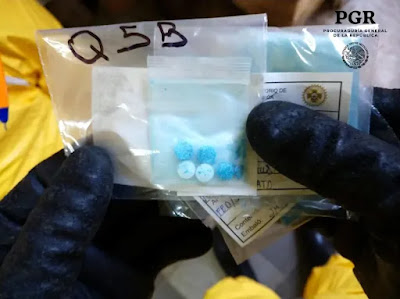
The Drug Enforcement Administration is advising the public of an alarming emerging trend of colorful fentanyl available across the United States. In August 2022, DEA and our law enforcement partners seized brightly-colored fentanyl and fentanyl pills in 18 states. Dubbed “Rainbow Fentanyl” in the media, this trend appears to be a new method used by drug cartels to sell highly addictive and potentially deadly fentanyl made to look like candy to children and young people.

“Rainbow Fentanyl—fentanyl pills and powder that come in a variety of bright colors, shapes, and sizes—is a deliberate effort by drug traffickers to drive addiction amongst kids and young adults,” said DEA Administrator Anne Milgram. “The men and women of the DEA are relentlessly working to stop the trafficking of rainbow fentanyl and defeat the Mexican drug cartels that are responsible for the vast majority of the fentanyl that is being trafficked in the United States.”

The DEA Seattle Field Division covers Washington, Oregon, Alaska, and Idaho. At this time, the DEA is aware of brightly-colored fentanyl seized in Oregon (Portland and Tigard), Alaska (Anchorage), and Idaho (Coeur d'Alene), and expects to see it in Washington as well.

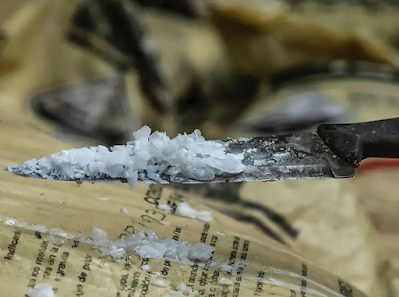
“Fentanyl is the deadliest drug threat we face today,” said DEA Acting Special Agent in Charge Jacob D. Galvan from the Seattle Field Division. “It doesn’t matter what color, shape, or form it comes in; just two milligrams of fentanyl – the equivalent of 10 to 15 grains of salt - is enough to kill someone. The DEA Seattle Field Division is seizing record amounts of fentanyl and we will continue this important work because we know American lives are at stake.”


Brightly-colored fentanyl is being seized in multiple forms, including pills, powder, and blocks that resembles sidewalk chalk. Despite claims that certain colors may be more potent than others, there is no indication through DEA’s laboratory testing that this is the case. Every color, shape, and size of fentanyl should be considered extremely dangerous.

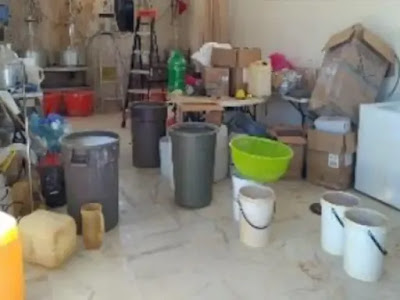
Fentanyl made by Mexican drug cartels in inexpensive labs, such as the one above, is flooding the U.S.

Fentanyl is a synthetic opioid that is 50 times more potent than heroin and 100 times more potent than morphine. Just two milligrams of fentanyl, which is equal to 10-15 grains of table salt, is considered a lethal dose. Without laboratory testing, there is no way to know how much fentanyl is concentrated in a pill or powder.

Fentanyl remains the deadliest drug threat facing this country. According to the CDC, 107,622 Americans died of drug overdoses in 2021, with 66 percent of those deaths related to synthetic opioids like fentanyl. Drug poisonings are the leading killer of Americans between the ages of 18 and 45. Fentanyl available in the United States is primarily supplied by two criminal drug networks, the Sinaloa Cartel (CDS) and the Jalisco New Generation Cartel (CJNG). Larger amounts of fentanyl are being seized across the United States, US/Mexico Border, and in Mexico each month.

Monday, November 22, 2021

How Smaller Doses Of More Powerful Drugs Allowed Mexican Cartels To Overwhelm Mexican Police And Flood The US

"Sol Prendido" for Borderland Beat


A Sinaloa state police officer at a clandestine lab producing synthetic drugs, mainly meth, in Sinaloa state, June 4, 2019. A record-setting bust in October underscores how Mexico has become a hub for fentanyl. The Sinaloa and Jalisco New Generational cartels have increased production of the drug, a powerful synthetic opioid analgesic. A flood of fentanyl into the US has helped drive overdose deaths to new levels.

Ciudad Juárez, México - In late October, Mexican authorities seized a record-breaking quantity of fentanyl at a single laboratory in the northwestern state of Sinaloa, landing a major blow to the Sinaloa Cartel, officials said.

But security analysts and cartel operatives say the bust was only proof of the "unstoppable" production of fentanyl in Mexico.

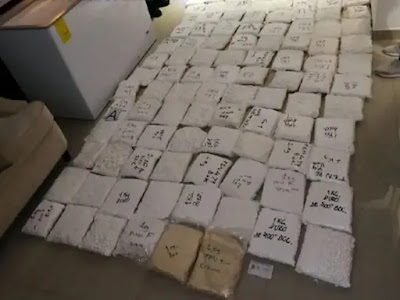
Mexican soldiers found 118 kilograms, or roughly 260 pounds, of fentanyl worth roughly $50 million in a lab on the outskirts of Culiacán, a city known for being Sinaloa's Cartel stronghold.

Mexican officials said the lab and warehouses seized in late October 2021 were used to store precursor chemicals used to make fentanyl.

Fentanyl is a powerful synthetic opioid analgesic similar to morphine but 50 to 100 times more potent, according to US authorities. Mexican drug cartels have relied on fentanyl more than any other drug to keep profits rising.

During the raid, authorities arrested Armando Bátiz Camarena, aka "El Inge," a known Sinaloa Cartel leader in charge of fentanyl production and shipment to the US, along with four of his men.

Authorities also seized four bags of fentanyl precursor in paste form, over 4 pounds of Inositol, a powder used as a cutting agent for drugs, five firearms, and more than $14,000 and 160 Venezuelan bolivars.

Although this was the biggest fentanyl bust in Mexico's history, it might not have any effect on the drug trade. It also may only be a sign of how Mexico is becoming the biggest player in fentanyl production.

"If Mexican authorities seized more than 100 kilograms, it means criminals are producing at least several tons," Manelich Castilla, former commissioner of Mexico's Federal Police, told Insider.


Fentanyl is easier to produce than cocaine or heroin since it requires just a few chemicals and some very rudimentary equipment, Castilla explained.

"It is very easily produced and 20 times more profitable than any other drug. You only need a very small dosage to create addiction," he said.

Manelich said that the fact that small doses of fentanyl could provide such intense effects means it's easier to smuggle.

"To transport fentanyl you don't need big shipments. Now you can hide a very profitable load inside a trailer container and it would be almost impossible to find," he said.

Mexico's defense secretary said earlier this year that fentanyl could be made in a few hours and was worth about $5,000 a kilogram in Mexico — a price that rises to about $200,000 in the US.

In a sign of the scale of production, US authorities intercepted 17,584 pounds of meth and 389 pounds of fentanyl in a tractor-trailer crossing into the US near San Diego on November 17. Both amounts would be the largest seizures of either drug in the US in 2020 or 2021, US officials said.

Potent product

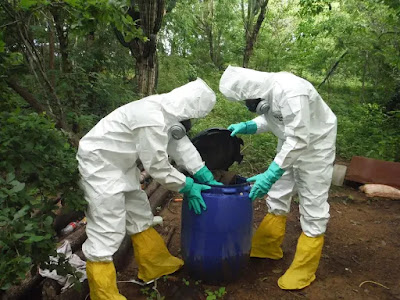
A chemical specialist in a protective suit with pills seized at a clandestine lab processing fentanyl, in Mexico City, December 12, 2018. A Sinaloa Cartel operative in Culiacán who asked not to be identified told Insider that the busted lab was "very small" compared to production around Sinaloa.

"They busted one, and immediately some other 10 started operating not very far from that one," the operative said.

The operative said fentanyl labs operate on a "mobile basis."

"Some years ago the old bosses used to set established fentanyl labs inside warehouses or abandoned houses, but we learned that once they busted that lab, the loss was too much," the operative said. "So now we set up mobile labs in the middle of the woods and cook only small batches in several labs at the same time to build a big shipment."

On a trip to Sinaloa state in early 2021, Insider visited a fentanyl lab operated by the Sinaloa Cartel. One of the lab operators described how cooks are trained to mix fentanyl "according to US needs."

"The cook learned from a Chinese man brought all the way here" by the cartel, the operator told Insider, adding that the cook "is the only one who knows the recipe."

"But many started dying because we still didn't have the right recipe, and some of them were not aware of the potency of the new product," the operator added.

Mexican authorities examine a clandestine lab suspected of producing synthetic drugs, in Sinaloa state, August 2016.

According to Manelich, most of the precursors needed to make fentanyl come from "the Asia region" but not exclusively from China. Shipments arrive by sea "inside one of many, many cargo [containers] processed at the port" in Colima state on Mexico's Pacific coast.

A leaked 2019 DEA report called the Sinaloa cartel "a prominent producer and trafficker of Mexico-based fentanyl" into the US. The powerful Jalisco New Generation Cartel has also ramped up its production of fentanyl.

The US Treasury Department recently sanctioned four men it said were CJNG members "operating through the port of Manzanillo in Colima" to import fentanyl precursors and other drugs.

"It is impossible to search all these shipments arriving into Mexico. What we need is a list of priority targets to know by name who are we looking for, who is in charge of these operations," Manelich said.

Fentanyl seizures in Mexico have risen over the past year, according to Mexican officials. In 2020, authorities seized 1,300 kilograms of the drug, compared to 222 kilograms in 2019 — an uptick of more than 400%.

More than 30,000 people in the US died of overdoses involving fentanyl in 2018, making it one of the most dangerous illicit drugs in history. Fentanyl-related overdose deaths have pushed total overdose deaths in the US to new levels.

Manelich said the only way out is a "coordinated agenda regarding addictions and security."

"Today Mexico does not have a policy or a campaign to point out the traffickers and the producers. The present administration's vision is very limited when compared to how things are done in the US," Manelich said.

Business Insider

Tuesday, December 26, 2023

Large Fentanyl Labs Beginning to Appear in Canada

"Socalj" for Borderland Beat


At a rural property an hour outside Vancouver in October, Canadian police found 2.5 million doses of fentanyl and 528 gallons of chemicals in a shipping container and a storage unit. Six months earlier, they raided a home in a cookie-cutter Vancouver subdivision packed with barrels of fentanyl-making chemicals, glassware, and lab equipment.

Thousands of miles away outside Toronto, police in August found what is believed to be the largest fentanyl lab so far in Canada, hidden at a property 30 miles from the US border crossing at Niagara Falls, NY.

Investigators in Canada say the labs are producing fentanyl for domestic users and for export to Australia, New Zealand and, they assume, the United States.

Saturday, November 2, 2019

Music’s Fentanyl Crisis: Inside the Drug That Killed Prince and Tom Petty

Chivis Martinez Borderland Beat From Rolling Stone


A Rolling Stone article from last year that I think is worth revisiting….

“The road and the studio are the only places I’ve ever felt completely OK,” Tom Petty told Rolling Stone last summer, explaining why he was launching one last grueling tour to mark his 40th anniversary with the Heartbreakers. But the roadwork wasn’t easy for him. Petty spent the entire 53-date tour struggling with severe pain from a fracture in his left hip. He got through it with painkillers and used a golf cart to move around backstage. “Tom was ill,” said his friend Stevie Nicks. “And he fought his way through that tour. He should have canceled and gone home and gone to the hospital, but not Tom. He was going to go down that river.”

Thursday, March 10, 2022

Jasper, Indiana: ‘Drug Epidemic A Matter Of Time:’

"Sol Prendido" for Borderland Beat

When Indiana State Police pulled over a vehicle traveling on Interstate 65 near Seymour this past November, it didn’t take long for them to suspect that a large amount of drugs was hidden inside.

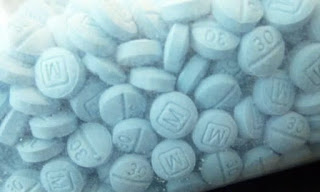
As police combed through the vehicle, they found crystal meth, loaded handguns and $2,000 in cash. But one of the arresting officers noticed something else that he later referred to in court records as a national “epidemic” — a plastic bag containing 10 blue pills that he suspected “were disguised as prescription medications but were really fentanyl.”

Federal authorities say pills like these are part of a worrying trend seen across the country as criminal drug networks in Mexico and elsewhere ramp up production of fentanyl, a synthetic opioid that is more potent than heroin but much cheaper to produce and distribute.

Last year, the U.S. Drug Enforcement Administration said its agents had seized a record 9.5 million of counterfeit prescription pills containing fentanyl from January to September, including some 3.8 million that contained lethal amounts of the drug.

That 10-month total was more than the number pills the agency had seized over the previous two years combined.

And some local law enforcement officials now fear that an influx of these pills could be the next wave in a decades-long drug crisis that has killed at least 153 people in Bartholomew County since 2015.

“I think you’re going to see the pill issue become an even bigger issue, if it isn’t already, as it comes north through the United States,” said Bartholomew County Sheriff Matt Myers.

So far, most local fentanyl seizures still involve the powder form of the drug, though Columbus police have seized counterfeit Xanax pills containing fentanyl in the past, Columbus Police Department spokesman Lt. Matt Harris said.

In Jennings County, law enforcement officials suspect that the pills are already moving through the area but have not yet intercepted any. Jennings County Sheriff’s Chief Deputy David Turner said sheriff’s deputies there are concerned that the fake pills will drive up “senseless deaths.”

“It’s just a matter of time,” Turner said, referring to the chances that the pills make their way to the Columbus area.

‘Nationwide surge’

The increase in fentanyl-laced pills in the United States, described by federal officials as a “significant nationwide surge,” represents the latest shift in the multi-billion-dollar illegal drug trade, officials said.

In recent years, drug traffickers have increasingly turned to fentanyl because it is cheaper and easier to produce than heroin and other drugs, according to the DEA.

Soon after that, fentanyl started finding its way into other drugs like methamphetamine, cocaine, marijuana, making them cheaper, more addictive and deadlier, federal officials said.

Now, drug traffickers are mass producing fentanyl in clandestine labs using ingredients largely made in China and have started churning out fentanyl pills under the guise of prescription medications, including Percocet, Adderall, Xanax, oxycodone, among others.

These drugs are increasingly being sold online and delivered by mail. And users often have no idea that they are buying fentanyl, leading to accidental overdoses and “killing unsuspecting Americans at an unprecedented rate.”

U.S. Customs and Border Protection has reported seizing an increasing amount of fentanyl over the past several years.

The agency seized about 11,200 pounds of the drug during fiscal year 2021, up from nearly 4,800 the year before and 2,800 in fiscal year 2019. At the same time, drug overdose deaths have continued to surge in the United States, with over 100,000 Americans now dying from overdoses per year, up from 52,000 in 2015, according to the Centers for Disease Control and Prevention.

“It’s cheap and easy to manufacture. … Drug dealers are very greedy people. They don’t care whose lives they are destroying. All they care about is that they’re making money.”

In Bartholomew County, deaths from drug overdoses have nearly doubled over the past few years — from 17 in 2018 to 33 last year, reaching their highest levels on record in each of the previous two years, according to data from the Bartholomew County Coroner’s Office.

Experts believe one of the main culprits of the increase is fentanyl, which is now the leading cause of death among Americans ages 18 to 45, according to the CDC.

Locally, fentanyl is becoming “primary fatal drug in drug overdoses,” said Bartholomew County Coroner Clayton Nolting.

For the Mexico-based Sinaloa Cartel and Cartel Jalisco New Generation, who federal officials say are responsible for most of the fentanyl coming into Indiana, the profit margin on the drug “is through the roof,” said Michael Gannon, assistant special agent in charge at the DEA’s Indianapolis Field Office.

“It’s cheap and easy to manufacture,” Gannon told The Republic. “…Drug dealers are very greedy people. They don’t care whose lives they are destroying. All they care about is that they’re making money.”

‘Not getting any better’

Amid this backdrop, Myers traveled to Washington, D.C. last month to attend the National Sheriff’s Association’s annual conference, but said he “didn’t get very encouraging news” about the state of affairs in the nation’s ongoing drug crisis.

At the conference, U.S. Customs and Border Protection and other federal agencies discussed trends in crime, particularly the flow of drugs into the United States, Meyers said.

“I do not see it getting any better,” said Myers, who sits on the association’s national drug enforcement and homeland security committees.

“There are more drugs coming in from the southwest border at a rapid pace,” Myers added. “Fentanyl is the drug of choice coming across the border. … And the reason (the cartels) are doing this is because the cartels can make much more money pressing pills.”

Now, law enforcement is racing to adapt to the evolving drug trade.

Federal authorities near the U.S.-Mexico border are finding fentanyl pills strapped to the legs of drug runners, inside fish coolers, concealed in hidden compartments in vehicles, among other locations.

Last week, federal authorities in the border city of Nogales, Arizona, seized more than 37,000 fentanyl pills concealed in the spare tire of a vehicle, according to U.S. Customs and Border Protection. The pills had an estimated street value of $1.13 million.

A few days later, border patrol agents in Nogales seized another 1,500 fentanyl pills, capping off what CBP described as a “busy week.”

In November, two men were sentenced to lengthy prison terms after ordering enough supplies from China to make 2.5 million fentanyl-laced pills in a backyard pill-pressing operation they ran near Seattle, The Associated Press reported. The pair had obtained equipment that could make their pills appear to be pharmacy-grade oxycodone instead of fentanyl.

In December, the DEA said that its agents in Indiana, Illinois and Wisconsin had seized 145,000 fentanyl pills, 29 guns and over $647,000 in U.S. currency over the previous four months.

Earlier this month, police in Arizona found 227,000 fentanyl pills concealed in large buffetstyle containers filled with food.

On Tuesday, a Louisville man was arrested after police found 15,000 fentanyl pills in his home, one week after Fort Wayne police seized nearly 1,200 pills believed to contain fentanyl.

“That’s probably what you’re going to start seeing here,” Myers said. “Pills are something that we didn’t see a lot of here at first. I think you’re going to see it a lot more.”

Myers is urging people to not buy prescription drugs off the street or from unauthorized online sources, warning that “you’re putting your life at risk, especially in today’s world.”

‘Not slowing down’

However, fentanyl is not just arriving through the U.S.-Mexico border, said Steve Bansbach, spokesman for CBP’s Chicago field office, which covers Indiana and monitors about 20% of all international mail coming into the United States.

“We see a lot (of fentanyl shipments) from China, Hong Kong, the Netherlands,” Bansbach said. “Those are usually the big countries that we see here locally.”

“You’re starting to see a lot more precursors for fentanyl,” Bansbach added. “People are making fentanyl, more mass production. You have to worry about what is being added to that fentanyl. That is something that we’re always worried about because you can have another additive that can be added that changes the whole chemical makeup and could be actually more deadly than your original fentanyl.”

Locally, officials hope to counter the rise of fentanyl through education and outreach. But they remain concerned that the synthetic opioid is going to continue to have a large share of the illegal drug market for years to come, fueling more overdose deaths and destroying more lives.

“We’ve done everything we can to keep these drugs out, but (the flow of drugs) isn’t slowing down,” Myers said. “ … And they’re coming in larger amounts and more lethal.”

Dubois County Herald

Thursday, April 13, 2023

Tranq-Laced Fentanyl Named as "Emerging Threat to US" by Biden Administration

"Socalj" for Borderland Beat

"This is the first time in our nation's history that a substance is being designated as an emerging threat by any administration," Gupta said.


In an unprecedented move, the US government issued a grave new warning about a cocktail of illegal street drugs made of fentanyl and xylazine that's fueling another wave of American overdose deaths.

"I'm deeply concerned about what this threat means for the nation," said Dr. Rahul Gupta, head of the White House Office of National Drug Control Policy. Xylazine, known on the street as Tranq, was first linked to drug deaths in the Northeast but has since spread rapidly in Southern and Western states.

Speaking with reporters ahead of the public announcement, Gupta said the Biden administration will formally notify Congress about the public health threat and will then roll out a plan to combat the crisis over the next 90 days.

"This is the first time in our nation's history that a substance is being designated as an emerging threat by any administration," Gupta said.

Wednesday, December 21, 2022

DEA Seizes Over 379 Million Lethal Doses of Fentanyl in 2022

"Mica/DrivingMssql" for Borderlandbeat.com
Drug Enforcement Administration Announces the Seizure of Over 379 million Deadly Doses of Fentanyl in 2022

Thursday, September 1, 2022

How Two Mexican Drug Cartels Came To Dominate America’s Fentanyl Supply

“Mica” for Borderland Beat 


How Two Mexican Drug Cartels Came to Dominate America’s 
Fentanyl Supply
The Sinaloa and Jalisco organizations are a dominant source of the synthetic opioid, a leading cause of the U.S.’s record overdoses

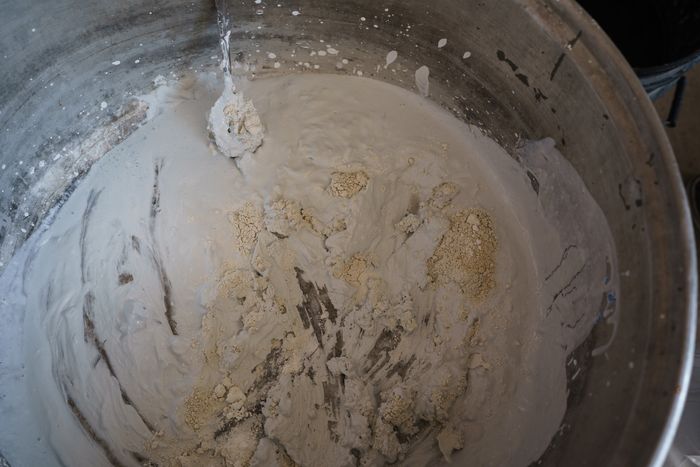
CULIACÁN, Mexico—At a half-built house in a barrio, a longtime Sinaloa cartel employee used a shovel to mix chemicals in a simmering oil barrel.

His concoction was an illegal form of fentanyl, which Mexican criminal organizations are churning out at high volume in laboratories and smuggling across the border. In a six-day workweek, the cook said, he can make enough fentanyl for hundreds of thousands of doses.

With business savvy and growing power in Mexico, the Sinaloa and rival Jalisco cartels dominate the market for supplying fentanyl to the U.S. They cornered the market after China cracked down on fentanyl production several years ago and are now churning out bootleg versions of the highly potent synthetic opioid that, in its legal form, is used under prescription to treat severe pain.

Fentanyl’s inexpensive, easy-to-replicate formula has boosted its appeal to criminal networks. It is also fueling an overdose crisisthat claimed more than 108,000 lives in the U.S. last year, a record.

“If it were an athlete, people would call it ‘The G.O.A.T.,’ ” said Jim Crotty, who served as deputy chief of staff at the Drug Enforcement Administration from 2019 to 2021. “It is in fact the most pernicious, the most devastating drug that we have ever seen.”

Fentanyl made by Mexican drug cartels in inexpensive labs, such as the one above, is flooding the U.S.

Like a factory worker at a multinational corporation, the 25-year-old fentanyl cook is part of a globe-spanning production line manufacturing the cartels’ highly profitable export. These crude labs—it is unknown how many there are—can be set up inexpensively and quickly, torn down and moved or abandoned to evade security forces.

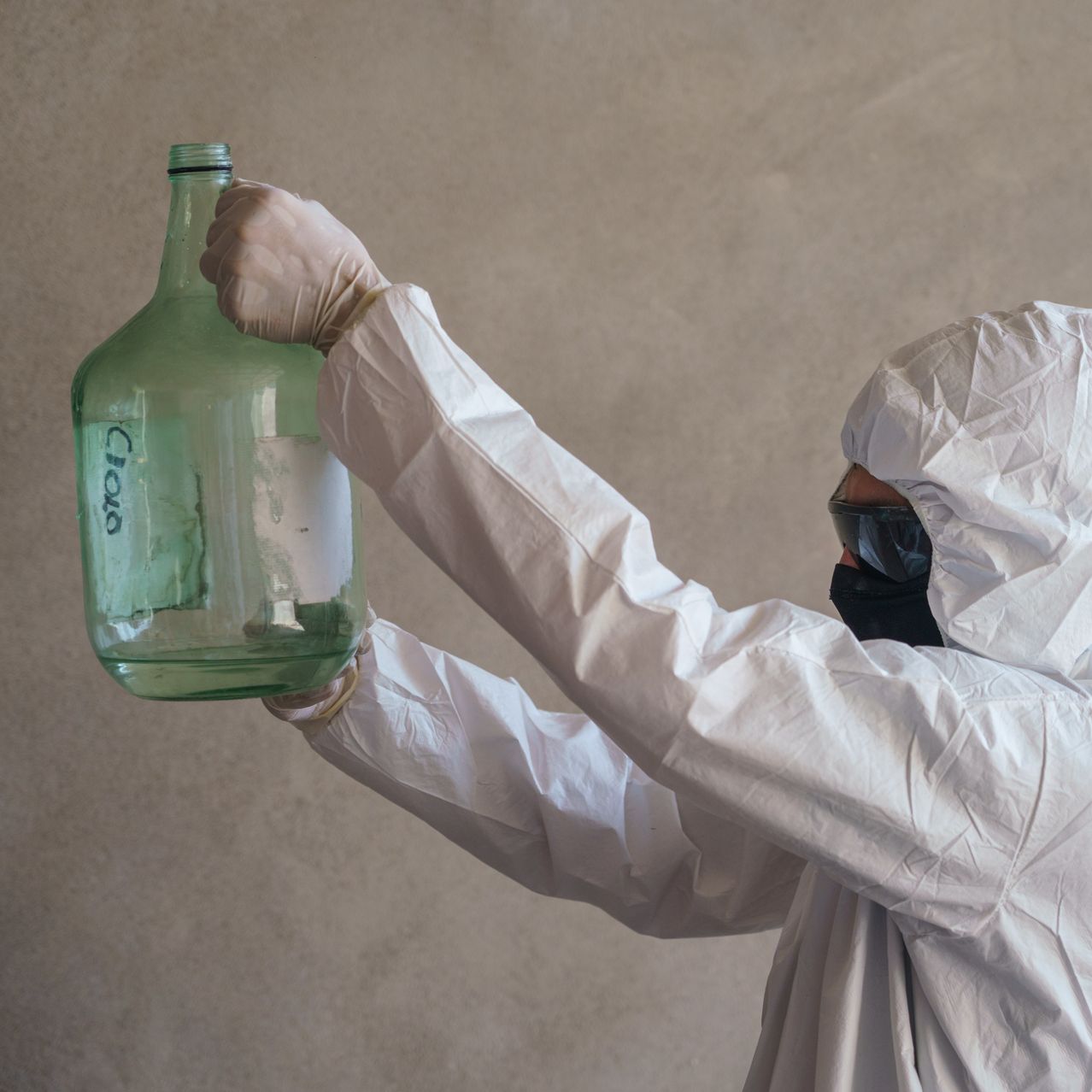
The cook said he makes up to $2,500 a week running his one-man lab, where he dons a hazmat suit, dark glasses and a black cloth mask. If he gets queasy, he said, he drinks milk. Jugs line the roughly 10-by-10 foot lab, including one containing a clear liquid marked “Pure Acetone.” Others are marked “Fentanyl XXX,” and “Chinese Chemical.”

The two cartels are named for their respective strongholds in states on Mexico’s Pacific Coast. Sinaloa is a decades-old criminal organization deeply embedded in the economy, politics and culture of Mexico’s wild northwest, analysts and officials said. Jalisco, farther south, is a relative upstart, and has violently challenged Sinaloa for market share.

Fentanyl production is simpler than heroin, because it is entirely synthetic and doesn’t require cultivating the poppies needed for heroin. Busts of Mexican labs or large seizures at the border can be quickly offset by new batches without having to wait to harvest crops or pay farmers.

It is also less expensive to make. The plant-based opium needed to produce a kilogram of heroin can cost producers about $6,000, while the precursor chemicals to make a kilogram of fentanyl cost $200 or less, according to Bryce Pardo, associate director of the Rand Corp.’s Drug Policy Research Center, who helped lead a recent bipartisan report on synthetic opioids.

“Synthetic opioids offer economic and tactical advantages that allow criminals to vastly outpace enforcement efforts,” the report said. Illegal drug exports to the U.S. from Mexico are worth tens of billions of dollars annually, it estimates, with fentanyl a growing share of the business.

Heroin’s profile has been shrinking as fentanyl becomes more available. Some Mexican poppy farmers in the mountains of Sinaloa say they have lost income as cartels shift away from heroin, and have abandoned their fields.

A statue of Jesus looms over Culiacan, which is dominated in many other respects by the Sinaloa cartel.

‘Principal product’

The Sinaloa cartel is the market leader, said Renato Sales, Mexico’s former security chief. U.S. and Mexican officials likened it to how a company works, manufacturing and marketing an array of illegal drugs and cultivating links to suppliers in dozens of countries in Latin America, Europe and Asia. The cartel is believed to have different units handling jobs such as security, money laundering, transportation, production and the bribing of public officials.

The cartel dominates the economy and life of Culiacán, a semitropical city of luxury cars, gated neighborhoods and barrios. The downtown includes a shrine to Jesús Malverde, a bandit whom many of Sinaloa’s drug traffickers have adopted as a popular saint. A cemetery housing air-conditioned tombs three stories tall is a hallowed resting place for prominent drug lords, and their not-so prominent hit men, some of whose plots are bought in bulk by their bosses.

At the city’s airport gift shop, visitors can buy baseball caps emblazoned with the number 701, a reference to the ranking in the 2009 Forbes list of richest people of Joaquin “El Chapo” Guzman, the drug lord and Sinaloa native son serving a life sentence in a supermax prison in Colorado.

The U.S. attorney’s office in San Diego in June said 26 people were indicted following a two-year investigation into what law-enforcement officials described as a sprawling operation extending from Sinaloa. Drugs seized included methamphetamine, cocaine, heroin and nearly 500,000 fake pills laced with fentanyl, investigators said. The DEA identified alleged couriers, stash-house managers and people who smuggled proceeds back to Mexico.

A separate DEA operation in 2020 led to the arrest of more than 600 alleged Jalisco cartel members in the U.S. That cartel is Mexico’s fastest-growing and most violent. It is fighting with Sinaloa for control of seaports where fentanyl’s chemical ingredients arrive from China as well as routes through the country and border crossings into the U.S.

Jardines del Humaya, a cemetery where many Sinaloa cartel members are buried in opulent mausoleums.

Illegal fentanyl production has flared in the past. A 2005 fentanyl surge in parts of the U.S., including the Midwest, led authorities to a single illegal lab in the city of Toluca, near Mexico City. Shutting it down helped stem the problem for a time.

Fentanyl metastasized into a broader crisis in the 2010s, as drugs flowed from China, sometimes through Mexico, and the cartels ramped up their own production. The eastern half of the U.S. was particularly hard-hit as powdered fentanyl was mixed into the heroin supply, sometimes catching users off guard and leading to an increase in fatal overdoses.

In May 2019, under pressure from the U.S., China put fentanyl-related drugs under a controlled regulatory regime. The next year, seizures of fentanyl from China in the U.S. dropped sharply, according to a Government Accountability Office report.

“As we all know, China is not a democracy,” said Jim Carroll, U.S. drug czar under former President Donald Trump. “They can take very quick adverse action against these producers.” Chinese chemical manufacturers continue to sell the ingredients for fentanyl, many of which have a range of legitimate uses.

Marketing savvy

Mexican cartels were primed to take advantage. They already had established trafficking networks built around drugs like cocaine, marijuana and heroin, said Uttam Dhillon, who served as acting DEA administrator under Mr. Trump. And they had relationships with Chinese chemical makers, and expertise running drugmaking labs, through their production of methamphetamine, another synthetic drug they are sending to the U.S., Mr. Dhillon said.

The DEA said the cartels are pushing their synthetic wares into more parts of the U.S. Methamphetamine is more present in some eastern states where that drug was once rare. And fentanyl is growing in the West. Its potency and the lack of quality control in the black market make it easy to cause overdoses—including when users don’t know that fentanyl is laced into or simply sold as other drugs.


 A man burns a fentanyl pill to check its quality.


Fentanyl pills, which are often disguised as legitimate opioids.

The drug often arrives in the form of fake tablets made to look like prescription drugs, including pain pills, law-enforcement authorities said. The DEA believes these dupes—often stamped to look like real 30 milligram oxycodone pills—are aimed at driving prescription drug users toward an illicit, cartel-made product.

The cartels “don’t just fill a void, they create a market,” Mr. Dhillon said.

The pills are so ubiquitous that they have been falling in price, creating pressure on the cartels to roll out new products, according to a 27-year-old fentanyl producer who runs a clandestine lab in Culiacán. He said he and a partner are experimenting with a new version meant to be 30% more potent than the typical fake oxycodone tablets, known as M30s.

The new pills, colored pink, yellow and green, have the shape of a skull, an iconic Mexican folkloric image, and don’t try to mimic real medication. They are also made with butter flavoring so that, when melted on foil with a flame, the pills leave a golden trail and smell like caramel popcorn, telltale signs of quality, said the producer.

He said he has made as many as one million pills in a week. Another worker in his lab had to periodically stop one of their machines—a $4,000, Chinese-made pill press—to clear jams as it ran on a recent, humid day.

“The M30 is not working very well. Everybody is making them,” the producer said. The new pill, he said, “will generate a lot of demand.”


A clandestine laboratory in Sinaloa. The cartels “don’t just fill a void, they create a market.”

Common chemicals

Fentanyl market dynamics have proven hard to disrupt. One problem is that many of the precursor chemicals made in China are also used in legitimate pharmaceuticals. Even when some are controlled, fentanyl makers can pick different inputs among an array of available chemicals, the recent U.S. bipartisan report said.

Take the chemical 4-piperidone, which is a common fentanyl component that is also used for legitimate pharmaceutical research.

Some 160,000 companies in China produce chemicals used in drug assembly in batches as small as tens of metric tons, the State Department estimated in early 2021, although estimates vary widely.

Rahul Gupta, director of the Biden White House’s Office of National Drug Control Policy, said the U.S. is asking China to enforce proper labeling of chemical shipments and to agree on which regulated chemicals can be used to make fentanyl so they can be tracked.

A 2021 report from two researchers at the Institute of Criminal Investigation of People’s Public Security University of China, the country’s highest police academy, pointed to weak training and unclear lines of command within China’s drug enforcement divisions. The researchers said those inspecting chemical plants often don’t have the means or know-how to identify fentanyl precursor chemicals.

The U.S. wants China to apply what are known as “know your customer procedures” to chemical makers so that manufacturers are accountable for where their products go, Dr. Gupta said.

China disputes the U.S. characterization of China’s role in the illicit fentanyl supply chain. A statement from the Chinese embassy in Washington, D.C., touted China’s efforts to control drug precursors and said it was untrue that these chemicals undergird the U.S. fentanyl problem. “The U.S. has itself to blame for the root cause of fentanyl abuse in the country,” it said.

A stiffer Chinese crackdown on precursors might not disrupt the market or slow the cartels because they could buy chemicals from other countries, including India. “There’s lots of places these same chemicals can come from,” said Rep. David Trone (D., Md.), who co-chairs a federal commission on synthetic opioid trafficking, which is behind this year’s bipartisan report, during a recent conference.


Chemicals used to make fentanyl, pictured at a Sinaloa safe house, often come from China, and can have other, legitimate purposes, which makes them hard to interdict.


A batch of fentanyl, which would later be dried in the sun and packed as kilograms of powder.

To try to stop fentanyl precursors from entering Mexico from Asia, President Andrés Manuel López Obrador put the country’s ports and its largest airport in Mexico City under the control of the Mexican navy.

The navy said in June it had seized around 320 tons of illicit-drug chemicals in the past six months. Mexican authorities have also destroyed about 1,000 labs, 90% of them in Sinaloa producing synthetic drugs, mostly methamphetamine, in the 3½ years since Mr. López Obrador took office, a senior Mexican navy officer said.

Since 2017, Mexico has dismantled some 22 fentanyl production sites, said Oscar Santiago Quintos, head of the criminal intelligence agency of the attorney general’s office. In a bust in July, Mexican soldiers captured 543 kilos of what they said was fentanyl, the single largest seizure in Mexican history.

U.S. seizures last year included 20.4 million fake pills, according to the DEA. Fentanyl and other drugs are often ferried across the southern border hidden in secret compartments of vehicles.

U.S. officials and analysts in both countries have criticized Mr. López Obrador for failing to curb the cartels’ growing power. The Mexican president has said he is focused on what he calls the economic roots of Mexico’s lawlessness and violence, rather than dismantling the cartels.

Cross-border cooperation over security matters has been strained since U.S. agents arrested a former Mexican defense minister on drug conspiracy charges in 2020. The U.S. dropped charges after Mexico threatened to curtail cooperation. Mexico passed legislation that U.S. officials said made it harder to work with their Mexican counterparts.

The Sinaloa cartel was forged from close-knit families in the mountains near Culiacán, who for generations grew marijuana and the opium poppies that provided the base for heroin. Alliances with Colombian cartels in the 1980s ramped up Sinaloa’s control of the flow of cocaine on routes to the U.S. In Culiacán, the cartel runs what amounts to a shadow government in a company town.

The fentanyl cook started with the cartel as a 14-year-old lookout. He measured by eye while cooking the fentanyl, holding two fingers against a bottle marked “chlorine” before pouring some into the oil-barrel mix. “We have our own formula,” he said. His efforts yielded a grayish-white, dough-like paste, which would be dried in the sun and packed as kilograms of powder for shipment across the border.

As he worked, an associate whispered that a car was coming to pick up cargo from the next room. Wrapped in plastic, the 16 kilograms, which represent about three days work, were marked with different codes—X30, Coco, PO8—identifying buyers. Each kilo could potentially yield tens of thousands of doses. “They are leaving tonight for the U.S.,” he said.

Bricks of fentanyl waiting to be picked up. Each kilo could potentially yield tens of thousands of doses.

Saturday, March 11, 2023

Mexican President to US: Fentanyl Is Your Problem

"Sol Prendido" for Borderland Beat


Mexico’s president said Thursday that his country does not produce or consume fentanyl, despite enormous evidence to the contrary.

President Andrés Manuel López Obrador appeared to depict the synthetic opioid epidemic largely as a U.S. problem, and said the United States should use family values to fight drug addiction.

His statement came during a visit to Mexico by Liz Sherwood-Randall, the White House homeland security adviser, to discuss the fentanyl crisis. It also comes amid calls by some U.S. Republicans to use the U.S. military to attack drug labs in Mexico.

The Mexican government has acknowledged in the past that fentanyl is produced at labs in Mexico using precursor chemicals imported from China. Fentanyl has been blamed for about 70,000 opioid deaths per year in the United States.

“Here, we do not produce fentanyl, and we do not have consumption of fentanyl,” López Obrador said. “Why don’t they (the United States) take care of their problem of social decay?”

He went on to recite a list of reasons why Americans might be turning to fentanyl, including single-parent families, parents who kick grown children out of their houses and people who put elderly relatives in old-age homes “and visit them once a year.”

His statement contrasted sharply with a Thursday tweet from U.S. Ambassador Ken Salazar saying a meeting between Sherwood-Randall and Mexico’s attorney general was meant “to enhance security cooperation and fight against the scourge of fentanyl to better protect our two nations.”

There is little debate among U.S. and even Mexican officials that almost all the fentanyl consumed in the United States is produced and processed in Mexico.

In February, the Mexican army announced it seized more than a half million fentanyl pills in what it called the largest synthetic drug lab found to date. The army said the outdoor lab was discovered in Culiacan, the capital of Sinaloa state.

In the same city in 2021, the army raided a lab that it said probably made about 70 million of the blue fentanyl pills every month for the Sinaloa cartel.

“The president is lying,” said Mexican security analyst David Saucedo. “The Mexican cartels, above all the CJNG ( Jalisco New Generation Cartel) and the Sinaloa Cartel have learned to manufacture it.”

“They themselves buy the precursor chemicals, set up laboratories to produce fentanyl and distribute it to cities in the United States and sell it,” Saucedo said. “Little by little they have begun to build a monopoly on fentanyl, because the Mexican cartels are present along the whole chain of production and sales.”

While it is true that fentanyl consumption appears to remain low in Mexico and largely confined to northern border areas, that may be because the Mexican government is so bad at detecting it. A 2019 study in the border city of Tijuana showed that 93% of samples of methamphetamines and heroin there contained some fentanyl.

Saucedo said fentanyl exports to the U.S. are so lucrative for Mexican cartels that they previously had not seen a need to develop a domestic market for the drug.

“It is true that fentanyl consumption in Mexico is marginal, but some mid-level cartels have begun selling it in border cities and in big cities like Leon, Mexico City and Monterrey,” Saucedo said.

On Wednesday, U.S. Sen. Lindsey Graham held a news conference, saying he wanted “to unleash the fury and might of the U.S. against these cartels.”

“The second step that we will be engaging in is give the military the authority to go after these organizations wherever they exist,” Graham said. “Not to invade Mexico. Not to shoot Mexican airplanes down. But to destroy drug labs that are poisoning Americans.”

López Obrador said Mexico would not accept such threats, calling them “an insult to Mexico and a lack of respect for our independence and sovereignty.”

López threatened to start a campaign in the United States asking Mexicans and Hispanics who live there not to vote for Republicans.

“We are going to issue a call not to vote for that party, because they are inhuman and interventionist,” López Obrador said.

Security analyst Alejandro Hope said López Obrador appeared trapped between his own “hugs, not bullets” strategy of not confronting cartels — which plays well among his supporters — and increasing U.S. pressure, especially from Republicans.

Hope said the Mexican president may not realize how much the issue of declaring Mexican cartels terrorist organizations could become a conservative rallying cry in the 2024 U.S. elections, just as former President Donald Trump’s call for a border wall was in 2016.

“The problem is that it puts the Biden administration in a terrible position, it puts it between the Republicans’ intransigence and López Obrador’s intransigence,” Hope said.

Marcelo Ebrard, Mexico’s top diplomat, wrote in his Twitter account Thursday that proposals like Graham’s would be “catastrophic for bilateral anti-drug cooperation.”

“They (Republicans) know that the fentanyl epidemic did not originate in Mexico, but in the United States,” Ebrard wrote. “They know that more work is being done against fentanyl now than ever.”

Later, Ebrard said that Mexico had seized over six tons of fentanyl — he didn’t specify over what time period or the purity of drugs — and that things would have been worse for Americans if that hadn’t been done.

“All the fentanyl seizures in Mexico, if they hadn’t been carried out, these pills would be causing or would have caused, not hundreds, (but) thousands of deaths in the United States. So no, there isn’t any tension with the United States,” he said.

Mexicans, both in government and outside it, are clearly afraid of fentanyl use increasing in Mexico. A civic group has launched a campaign of painting walls with the slogan “Mxsinfentanilo” — “Mexico without fentanyl” — and López Obrador has launched a series of anti-drug TV ads.

Still, López Obrador’s government appears to view fentanyl as a U.S. problem. In the ads launched in November, the government used videos of homeless people and open-air drug users in Philadelphia to try to scare young people away from drugs.


Saturday, November 19, 2022

Mexican Cartel Cooks Dispute DEA Claims of Rainbow Fentanyl to Appeal to Children

"Socalj" for Borderland Beat

The cook with the Sinaloa Cartel said that by adding food coloring to pure fentanyl, it would be impossible for dealers in the US to mix it with something else without the final drug user noticing.

The US Drug Enforcement Administration and police departments across the country have been warning about a new cartel strategy to sell fentanyl: pushing "rainbow-colored" fentanyl pills to hook children and young adults. But operatives in the Sinaloa Cartel, the Mexican criminal organization behind the biggest shipments of fentanyl to the US, told Insider their intention is actually the opposite.

US authorities began their campaign several months before Halloween, warning of alleged attempts by Mexican drug cartels to entice kids into drugs by selling rainbow-colored fentanyl pills and adding fentanyl to Halloween candies. In a statement published on August 30, DEA administrator Anne Milgram warned the public of "an alarming emerging trend of colorful fentanyl available across the United States."

"Rainbow fentanyl — fentanyl pills and powder that come in a variety of bright colors, shapes, and sizes — is a deliberate effort by drug traffickers to drive addiction amongst kids and young adults," Milgram said.

News stories and broadcasts began showing photos and videos of rainbow-colored pills and powder from seizures across the country. The reports described large quantities of colorful pills and cautioned parents to be on the lookout for them or things like them in their children's candy.


A cartel operative and a cook involved in the manufacture and shipment of fentanyl from Mexico told Insider that their intention was "actually the opposite" of what Milgram described. The coloring "is to make it look different than coke or white heroin," the fentanyl cook, speaking on the condition of anonymity, told Insider.

In 2021 alone, more than 100,000 people in the US died from fentanyl overdoses. Most were accidental deaths after using a substance like cocaine, heroin, or fake Percocet pills that had been laced with the powerful opioid.

"We know that some of the dealers in the US started mixing cocaine with 'fenta' without letting their buyers know, and that is very dangerous," the operative said. "Also we mix some of the heroin with fentanyl to make it more powerful, but we mark it, to let the buyer know that this one has 'fenta,'" he added. "Whatever happens when it's taken from our hands, it's not our problem. We get all the blame for the deaths, but we send a clean product, pure quality 'fenta,' or if its blow, just blow," he said. "If we are adding 'fenta' to the heroin, we are very clear that our batch has 'fenta' in it."

Despite the scare, a Washington Post review of news reports from mid-August to late October found only one case of accidental ingestion of "rainbow fentanyl" by a 2-year-old.

On November 17, however, the US Treasury Department announced sanctions against members of La Nueva Familia Michoacana, another Mexican criminal group, and accused it of marketing 'rainbow fentanyl' in "a deliberate effort to drive addiction amongst kids and young adults."

The Sinaloa Cartel operative denied that his organization is targeting kids or young adults in the US as their final users. "Why would we want to make kids addicts? What good would that do to us?" the cook said. "We want to sell what the people are asking for in the US, but not to kids or people who do not want to take drugs."

Right Recipe

Organizations like the Sinaloa Cartel and Cartel Jalisco Nueva Generación have been manufacturing fentanyl in the form of fake blue Percocet pills or adding it to heroin batches for at least four years. Fentanyl is cheaper to make because it is a synthetic opioid and doesn't require the time and expense of cultivating opium poppies to produce heroin or coca to make cocaine. Revenue from selling the opioid could be up to five times that of cocaine or heroin.

The drug is also easier to hide and transport because its potency means smaller quantities can still produce a strong high, though US authorities have reported seizing multi-hundred pound loads of the drug in recent months.


A leaked 2019 DEA report called the cartel "a prominent producer and trafficker of Mexico-based fentanyl into the United States," according to the investigative journalism project Forbidden Stories. A Sinaloa Cartel operative previously interviewed by Insider said that users in the US started asking for fentanyl-boosted heroin in 2015, but they didn't receive the order and recipes to cook it until 2019.

"The cook learned from a Chinese man, brought all the way here by the cartel," the cartel member said. "He is the only one who knows the recipe." "But many started dying because we still didn't have the right recipe, and some of them were not aware of the potency of the new product," he added.

Most of the chemicals used are illegally imported from China and Germany, according to the cook. As soon as the fentanyl powder reaches Mexico, they begin to cook in order to ship it to the US. "We cook from 10 to 20 kilos" — 22 to 44 pounds — "of heroin a day, and we work most of the week," the cook said. The cartels' increasing focus on producing fentanyl has been reflected in seizure data. In San Diego County alone, the amount of fentanyl intercepted by US Customs and Border Protection rose from 1,599 pounds in 2019 to more than 6,700 pounds in 2021.

Source Insider